Environment


See here.  The Times’ Green Blog writes:

The newly appointed leader of a House subcommittee that controls the Environmental Protection Agency’s budget, Representative Mike Simpson, Republican of Idaho, says he intends to slash the agency’s funding. “The E.P.A. is the scariest agency in the federal government, an agency run amok,” Mr. Simpson said in a statement on Friday. “Its bloated budget has allowed it to drastically expand its regulatory authority in a way that is hurting our economy and pushing an unwanted government further into the lives of Idahoans.”

Today, Vermont Law School’s Environmental Law Center launched its first annual Top 10 Environmental Watch List. Our environmental faculty and students from the Vermont Journal of Environmental Law researched more than 75 judicial, regulatory, and legislative actions before selecting what they consider the 10 most important environmental law and policy issues of 2010.   Read more at http://watchlist.vermontlaw.edu/.

With a student, I co-authored the article for No. 8 on the list, Supreme Court Reviews Genetically Modified Crops.

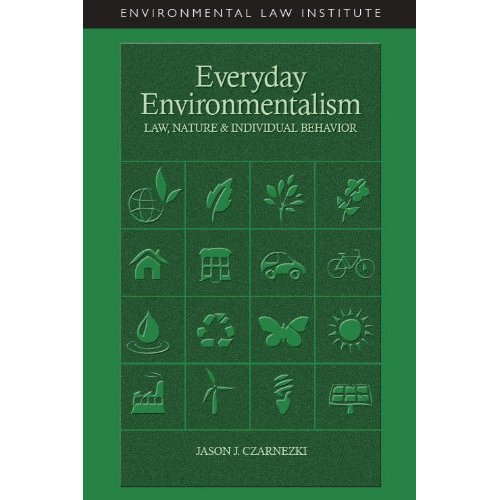
Sometime in 2006 I thought about writing a book, and in early 2007 I thought maybe this was a good idea.  In summer 2007, I wrote a book prospectus.  This month my first book will be published.  And now today, I am just shocked, almost 4 years later, to actually see you can pre-order (!!!) my book on Amazon.com.  Click here.  It’s titled, “Everyday Environmentalism: Law, Nature, and Individual Behavior.”  Here’s the product description:

Faced with the seemingly overwhelming prospect of global climate change and its consequences, is there anything that a person can do to make a difference? “Yes, there is!” says Jason Czarnezki. Writing as a lawyer and environmentalist, he addresses the small personal choices that individuals can make in order to have a positive effect on the natural world.  Czarnezki compellingly describes the historical and contemporary forces in the United States that have led to a culture of “convenience, consumerism, and consumption.” He also investigates the individual decisions that have the worst environmental impacts, along with the ecological costs of our food choices and the environmental costs of sprawl.  Ever aware of the importance of personal choice, Czarnezki offers a thoughtful consideration of how public policy can positively affect individual behavior.


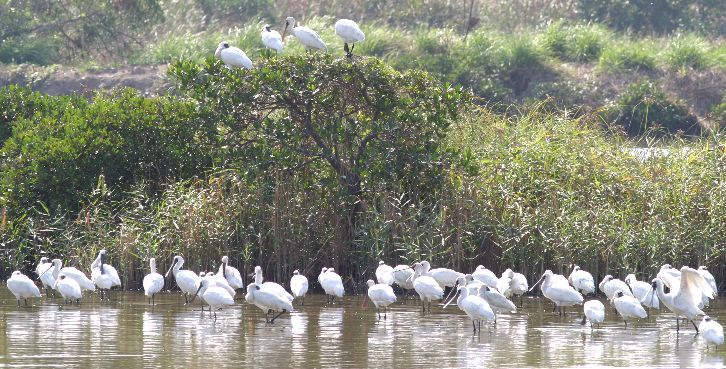
Today, due to the generosity of contacts at WWF in Hong Kong, we received a tour of Mai Po Nature Reserve in Hong Kong’s New Territories.   Mai Po is a large wetland reserve filled with very cool flora and fauna, and really is a bird lovers’ paradise.  Mai Po is protected by the Ramsar Convention on Wetlands, and our visit was truly a treat.   We saw mangroves, traditional shrimp ponds, fish farms (right outside the reserve), and beautiful flowers, and, with fancy digital binoculars and scopes, saw beautiful birds: spoonbills, herons, egrets, and ducks.

See here.

I’m off to China in less than 13 hours for a relatively long trip packed with events.  I’m meeting with environmental NGOs and academics in Hong Kong, including a much anticipated tour of Mai Po Nature Reserve.  Then off to Guangzhou for a series of lectures on climate change at Chinese universities, attending collaborative American-Chinese student research presentations as part of the Vermont Law School’s US-China Partnership in Environmental Law, meeting with public and private environmental officials, and doing some “public diplomacy” for the U.S. Consulate in Guangzhou.  Also on the agenda is a friend’s Chinese wedding in Xi’An and as much Chinese food as I can eat.  I’ll be exhausted by the time I arrive at the AALS Annual Meeting in San Francisco on the way home.

I’ve already posted about Sweden’s attempt to lower their carbon footprint through food policy.  And while I remain a bit skeptical of some biomass energy sources, this article describes efforts to reduce reliance on fossil fuels for heating in a Swedish city.

Bridget Crawford posts over at The Faculty Lounge about the relative size of environmental law faculties at the top environmental law programs in the country.  There seems to be an implicit suggestion (otherwise why bother collecting this data) that there may be a relationship between environmental law faculty size and top rankings.  I suspect this is the case given that more faculty in an area leads to more student programming, research, public outreach, and helps one potential have more USN&WR votes.  I had trouble downloading Bridget’s original data from the post, but her numbers for Vermont Law School are either far too low or slightly too high depending on whether she’s counting tenure-track/tenured faculty only, or wants to also included all full-time faculty that teach and write in the area of environmental law.  If it’s the former, Vermont Law School has, by my count, 13 tenure-track/tenured environmental law faculty, but if it’s the latter, the number is at least 32 environmental faculty since we have so many full-time long-term contract environmental faculty in the Environmental Law Center who teach and write in environmental law.

See here.  This will infuriate many environmentalists, and further outrage Democrats who are already outraged by potential extension of the Bush-era tax cuts.  The money quote from the NY Times Green Blog:

“Environmental advocates are furious. They fear a similar delay on the approaching start of one of the most far-reaching regulatory programs in American environmental history, the effort to curb emissions of carbon dioxide and other greenhouse gases.  But in a striking turnabout, the National Association of Manufacturers and the American Petroleum Institute — which have been anything but friendly to Mr. Obama — are praising his administration.”

I’ve been reading various articles trying to figure out what have been the successes and failures at COP16 in Cancun so far, and came across this nice summary of happenings so far.

« Previous PageNext Page »