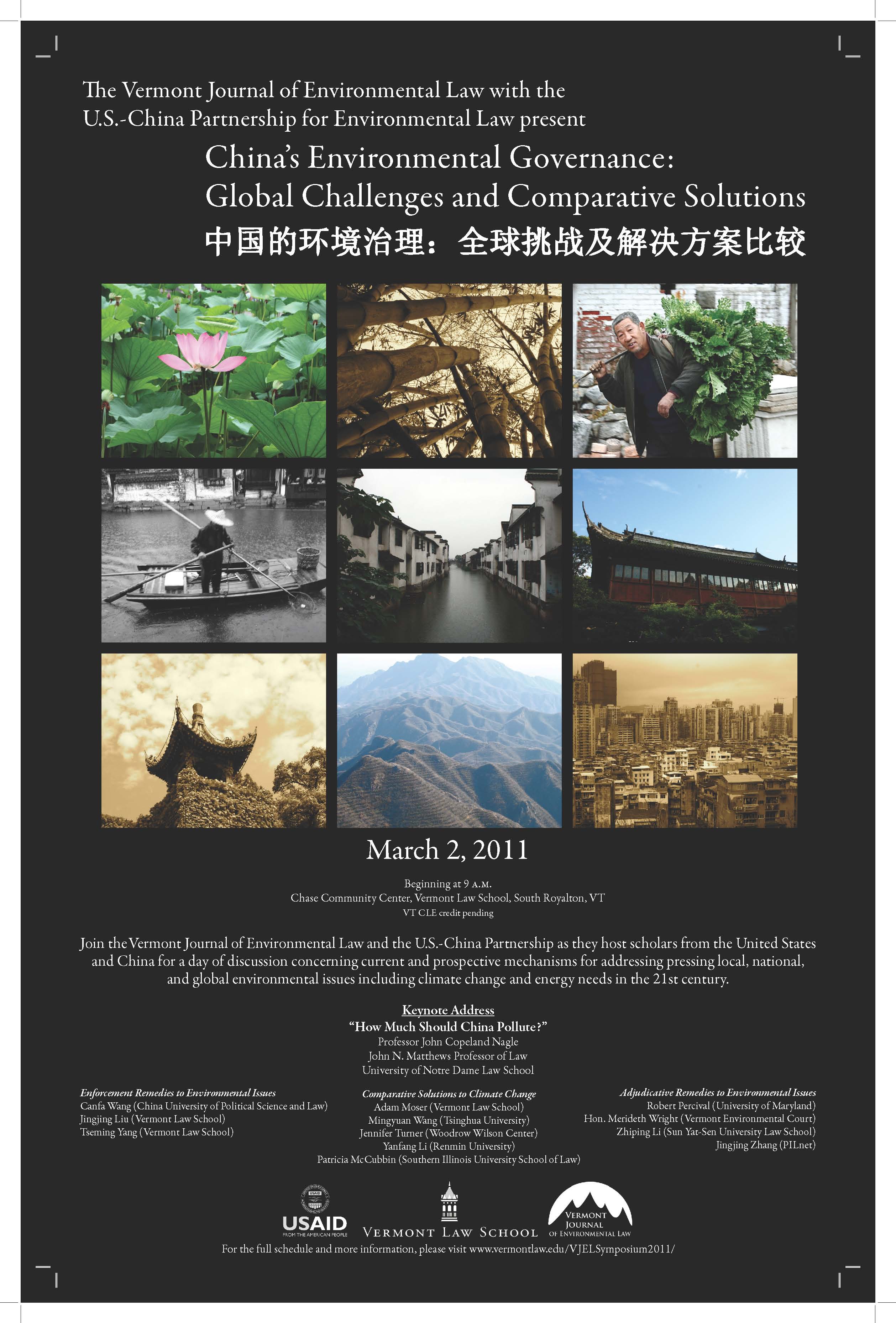
The Vermont Journal of Environmental Law with the U.S.-China Partnership for Environmental Law present
China’s Environmental Governance: Global Challenges and Comparative Solutions
February 14, 2011
The Vermont Journal of Environmental Law with the U.S.-China Partnership for Environmental Law present
China’s Environmental Governance: Global Challenges and Comparative Solutions
February 13, 2011
Over at The Faculty Lounge, they’ve decided to rank the “Most Productive Environmental Law Scholars 2005-2009 at “Top” Environmental Schools.” (It seems I’m #7.)
February 13, 2011
I’ve been thinking a lot about the power of social movements to create environmental change. I know many sociologists and political scientists have studied grassroots environmentalism as a way to generate political change, but in the U.S., major environmental legislation hasn’t been passed for decades yet some sort of local environmental social movement is afoot as it relates to food. People are genuinely interested in local and organic foods, regional food systems, composting, and universities are creating food-related programs. While I think many of these positives have yet to fully address the problem of making alternative agriculture affordable, food is the most initimate natural resource we all use and perhaps can be a facilatator for a greater environmental movement.
February 7, 2011
We screened the documentary film Gasland in my seminar today, and it was so depressing it completely sucked all energy out of the room. Imagine the scenes…tap water of fire, sick moms, pets losing fur; all due to the chemicals used in hydraulic fracturing that can pollute groundwater.
If this topic interests you, the University at Buffalo Environmental Law Program and the Baldy Center for Law and Social Policy will host the conference: Hydrofracking: Exploring the Legal Issues in the Context of Politics, Science and the Economy. The Call for Papers/Presentation is here.
February 2, 2011
…is the title of this interesting little opinion piece in the Times, offering up some ways to improve our food system. One idea I like, but I’ve never heard discussed from a public policy standpoint is how to encourage people to cook. The piece says:
Encourage and subsidize home cooking. (Someday soon, I’ll write about my idea for a new Civilian Cooking Corps.) When people cook their own food, they make better choices. When families eat together, they’re more stable. We should provide food education for children (a new form of home ec, anyone?), cooking classes for anyone who wants them and even cooking assistance for those unable to cook for themselves.
January 26, 2011
See here.
January 16, 2011
So says the title of this article in the Burlington Free Press.
January 14, 2011
On the good side, last night I finished the book Game Change, and started the book Lost Moon (which has literally been sitting on my shelf for literally 17 years since I met fellow Milwaukeean Jim Lovell and he signed a copy for me). After reading Game Change, two things stuck out: (1) Did John Edwards really think he could become President given her personal affairs?, and (2) Regardless of your views of Sarah Palin, she did energize the Republican base and really was not well-supported by McCain campaign due the very quick vetting process (if you can call it that).
Today was an absolutely crazy/busy day. With my partner at Yale, I walked the dogs, got the kids (who still have jetlag from the China trip) up and dressed, walked the older kid to school with younger kid in tow, took care of the younger kid all day, picked up older kid with younger kid in tow, dropped off car for partner downtown so she has it when bus gets in, took kids for snack, walked home (note: it’s cold in Vermont and sidewalks are still in poor condition from Wednesday’s snow), cooked dinner, gave kids bath, read stories and put kids to bed. During this day, I received too many emails to count, I’ve sent 59 emails so far, I had three work phone calls, and I’ve scheduled a dozen meetings for the next two weeks…it’s a good thing my younger daughter is very good at playing by herself when Daddy is on the phone.
In other news, here’s the NY Times article about the EPA actually using their Clean Water Act section 404 veto authority to stop a coal mining project. Additional commentary at Green Law. In my forthcoming book, in the chapter on sprawl, I write:
In terms of federal enforcement, EPA must more readily exert the veto authority granted to it under the Clean Water Act. Rather than acquiesce to what can become almost routine issuance of wetlands fill permits by the Corps, EPA could more actively review the effects of permit issuance for “unacceptable adverse effects.” EPA generally has been too reluctant to exert this authority.
Finally, in light of the ridiculously busy day, I refuse to do work tomorrow night. Go Pack.
January 14, 2011
Preliminary Schedule of VJEL 2011 Symposium:
China’s Environmental Governance: Global Challenges and Comparative Solutions
This year, the Vermont Journal of Environmental Law, in collaboration with U.S.-China Partnership, will be hosting our annual Symposium, entitled China’s Environmental Governance: Global Challenges and Comparative Solutions. The Symposium will take place on Wednesday, March 2, 2011. It will bring together scholars from China, the United States, and the local community, with panels on Comparative Solutions to Climate Change, Enforcement Remedies to Environmental Issues, and Adjudicative Remedies to Environmental Issues. John C. Nagle of the University of Notre Dame will be the keynote speaker.
9:00 AM — Breakfast
9:30 AM — Welcoming Remarks by Professor Siu Tip Lam (Vermont Law School)
9:45 AM — Panel One: Comparative Solutions to Climate Change
Including: Adam Moser (Vermont Law School), WANG Mingyuan (Tsinghua University), Jennifer Turner (Woodrow Wilson Center), LI Yanfang (Renmin University)
11:10 AM — Coffee Break
11:20 AM — Panel Two: Enforcement Remedies to Environmental Issues
Including: WANG Canfa (China University of Political Science and Law), Jingling Liu (Vermont Law School), Patricia McCubbin (Southern Illinois University School of Law)
12:45 PM — Lunch
2:10 PM — Panel Three: Adjudicative Remedies to Environmental Issues
Including: Robert Percival (University of Maryland), Honorable Merideth Wright (Vermont Environmental Court), LI Zhiping (Sun Yat-Sen University Law School), ZHANG Jingjing (Public Interest Law Institute)
4:00 PM — Keynote Address by Professor John Copeland Nagle (University of Notre Dame)
January 13, 2011
I just love it when the EPA actually decides to uses its veto power under section 404 of the Clean Water Act. Holly Doremus at Legal Planet has commentary here.


 JASON J. CZARNEZKI