Environment


I’ve started reading “Slow Food Nation: Why Our Food Should be Good, Clean, and Fair” by Carlo Pertrini.  In the Forward by Alice Waters, she writes, “We soon discovered that the best-tasting food came from local farmers, ranchers, and foragers, and fisherman who were committed to should in sustainable practices.”

More most be done to promote a local organic food system.  I am working on an article now discussing how law both impedes and can help facilitate such a market.  Not only does local chem-free food taste better, but it limits the environmental costs of food consumption.

Food choices can contribute to the climate crisis, cause species loss, impair water and air quality, and accelerate land use degradation.   For example, an estimated 25 percent of the emissions produced by people in industrialized nations can be traced to the food they eat.   The causes of these environmental costs are many—the livestock industry, a processed and meat-heavy diet, agricultural practices like pesticides and fertilization, and fossil-fuel intensive food transportation, factory processing, packaging and large-scale distribution systems.  These are traits of the dominant industrial food model.
In today’s Huffington Post, Vermont Law School Professor Jackie Gardina talked about BP and the threat of bankruptcy. See http://www.huffingtonpost.com/christopher-weber/why-the-gm-and-chrysler-b_b_648414.html.

The concern is that once a company files for bankruptcy, it may not longer be accountable for cleanup costs.  She argues to close this loophole Congress and the President must act to do such things as gain a security interest on BP’s property.

I am attempting to build a collection of used/recycled/old/worn/vintage T-shirts to wear in my Natural Resources Law and Frontiers in Environmental Law & Policy classes this year.  I’m looking for T-shirts that have designs about parks, nature, environment, sustainability, local food, vegetarianism, small farming, agriculture, climate change, energy, organic, earth, local food restaurants or anything else that has some sort of ecologically positive message.  Please sift through you old T-shirts (size L or XL) and if you find one, please deliver it to my office, home, the softball field, or even mail it to the Vermont Law School.  While I’m offering no money, I will attribute the source to you and you can feel good about recycling your old shirts (and limiting my consumption of new ones).  Any shirts I don’t wear will be given to a clothing charity.

…and not because of a Nelly video.

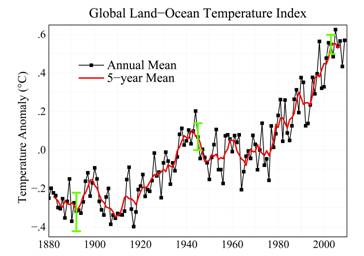
The NY Times Green Blog, citing NOAA, reports that “average global temperatures from April to June and from January to June were the highest ever recorded in those time periods.”

The graph below shows through the year 2009, the warmest years of the past century are 1998, 2002, 2003, 2004, 2005, 2006, 2007, and 2009.

Global Annual Mean Surface Air Temperature Change

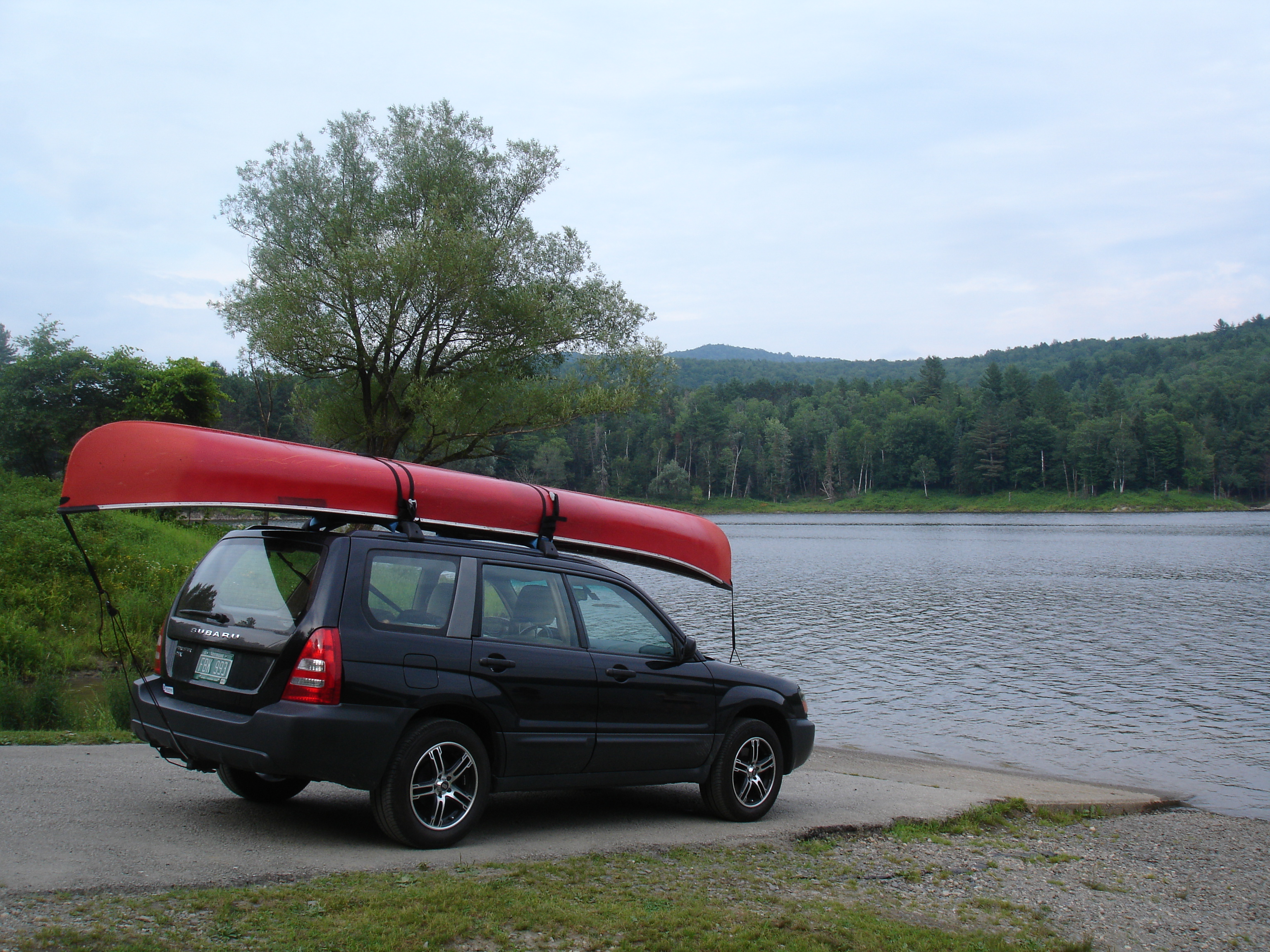
In classic Vermont fashion, today we went to Wrightsville Reservoir with our new-to-us canoe and our new-to-us Subaru.  There has been much debate in Vermont of late about appropriate recreational uses for man-made reservoirs and ponds, especially if they are used as a source of drinking water.  Wrightsville has a no wake and swimming area which we paddled through, but the jet ski that arrived on the boat launch just as we were finishing really lessened our experience.  While allowed on that part of the reservoir, the noise, exhaust and smell were quite terrible.

Another fantastic reservoir in Vermont is Green River Reservoir State Park where you canoe into your campsite.  Power boats are banned and the shoreline is completely undeveloped.  “The Green River Reservoir is a 5,113 acre park including a 653 acre Reservoir with 19 miles of shoreline, which is the longest stretch of undeveloped shoreline in Vermont,” according to the Friends of the Green River.

Photo: Our Subaru and canoe on the Wrightsville Reservoir Boat Launch.

My friend and Vermont Law School Professor David Mears has been awarded a Fulbright Scholar grant to teach and to assist the environmental law clinics at Sun Yat-sen University and the Center for Legal Assistance to Pollution Victims at the China University of Political Science and Law during the 2010-2011 academic year. He also intends to reach out to other universities across China that are interested in establishing environmental law clinics.

Read the full press release here.

David actually lives down the road from me in Montpelier, and will be living in the same apartment building in Guangzhou where I lived last year while on my Fulbright.

« Previous Page