I have just posted an new draft article on SSRN entitled, “The Future of Food Eco-Labeling: Organic, Carbon Footprint, and Environmental Life-Cycle Analysis.”  It can be downloaded at http://ssrn.com/abstract=1645860.

The Abstract:

Food choices contribute to the climate crisis, cause species loss, impair water and air quality, and accelerate land use degradation. The causes of these environmental costs are many—the livestock industry, diet, agricultural practices like pesticides and fertilization, and large-scale food transportation, processing, packaging and distribution systems. This Article describes the environmental consequences of the modern food system, and discusses existing public and private eco-labeling regimes, including carbon footprint labeling, country of origin labeling, and organic labeling under the U.S. Organic Foods Production Act and within the European Union. It also recognizes ambitious efforts like Sweden’s dietary information program that gives equal weight to climate and health and labeling program that requires food to be both produced organically and using low-emission production to meet certification requirements.


This Article considers the role of food eco-labeling in the United States in creating a sustainable food system. This Article discusses the merits of a creating a national eco-labeling program, replacing current federal organic food legislation; considers to what extent an American state could develop an food eco-labeling program that does not run afoul of existing government regulations about organic labeling; identifies the difficulties in developing an eco-label that considers a wider range of environmental assessment than existing organic and climate labeling programs, focusing in particular on the efforts of the European Food Sustainable Consumption and Production Round Table; and addresses the challenges to developing an environmental life-cycle eco-label that considers all phases of food production, processing and distribution.


This Article concludes that a state with a strong reputation for environmental awareness should, within the confines of the national organic certification program, develop a new environmental life-cycle eco-label that embodies and conveys to consumers a wider array of environmental information.

The Wall Street Journal reports that China has become the world’s top enery user, surpassing the United States.  China has already passed the U.S. in overall greenhouse gas emissions.  At the same time China is reluctant to accept its status as a economic and polluting powerhouse.

Let me start out by stating that the United States has failed in its leadership to develop international climate change policy.  And the Chinese government and Chinese scholars often point this out.  At the same time, China, in some sense, has not been willing to accept its role as a global leader.  At a Roundtable discusion in China that I participated in with Chinese scholars, it was clear that, for strategic purposes, China wants to be seen as the leader of the developing world (i.e., the king of the BASIC countries-Brazil, South Africa, India, China), but, at least on the environmental front, does not want to have the same level of responsibility as the developed world especially the U.S.  The problem is that on other accounts China deeply desires to a be superpower–see, e.g., Olympics, World Expo, UN Security Council.   The question is whether China’s dramatic rise comes with more responsiblity.  This concern might be why my Chinese colleagues and students often downplayed or denied that China is overtaking Japan as world’s second largest economy.

(Note: There is a large cultural aspect to this as well in terms of comfort level with accepting and announcing one’s own success, and choosing to impose one’s value systems on others.  Chinese and U.S. citizens and foreign policy are culturally different in this way.)

I’ve started reading “Slow Food Nation: Why Our Food Should be Good, Clean, and Fair” by Carlo Pertrini.  In the Forward by Alice Waters, she writes, “We soon discovered that the best-tasting food came from local farmers, ranchers, and foragers, and fisherman who were committed to should in sustainable practices.”

More most be done to promote a local organic food system.  I am working on an article now discussing how law both impedes and can help facilitate such a market.  Not only does local chem-free food taste better, but it limits the environmental costs of food consumption.

Food choices can contribute to the climate crisis, cause species loss, impair water and air quality, and accelerate land use degradation.   For example, an estimated 25 percent of the emissions produced by people in industrialized nations can be traced to the food they eat.   The causes of these environmental costs are many—the livestock industry, a processed and meat-heavy diet, agricultural practices like pesticides and fertilization, and fossil-fuel intensive food transportation, factory processing, packaging and large-scale distribution systems.  These are traits of the dominant industrial food model.

Since I just spent a year in China as a Fulbright Scholar and I grew up in Milwaukee, I found this “Letter from China” in The New Yorker, entitled “Pardon Me, Would You Have Any Pabst Blue Ribbon,” quite amusing.

I noticed a lot of PBR while in China, but I did not know it was going classy.  But I’m not surprised.  For example, Pizza Hut in China has fancy table service and is quite expensive.  Minivans, like the Honda Odyssey, are also considered very high end, especially by young men.

(Note: Despite its label and founding in Milwaukee, PBR is no longer brewed in Wisconsin.)

Hat Tip: Carl Yirka

If you teach statutory interpretation principles in any course, I offer up my favorite Supreme Court case: Nix v. Hedden (U.S. Supreme Court, 1893)

It asks an intriguing question – Is a tomato a fruit or a vegetable?

The full opinion follows (yes, it’s very short).

Nix v. Hedden, 149 U.S. 304 (1893)

MR. JUSTICE GRAY, after stating the case, delivered the opinion of the court.

The single question in this case is whether tomatoes, considered as provisions, are to be classed as “vegetables” or as “fruit,” within the meaning of the Tariff Act of 1883.

The only witnesses called at the trial testified that neither “vegetables” nor “fruit” had any special meaning in trade or commerce, different from that given in the dictionaries; and that they had the same meaning in trade to-day that they had in March 1883.

The passages cited from the dictionaries define the word “fruit” as the seed of plants, or that part of plants which contains the seed, and especially the juicy, pulpy products of certain plants, covering and containing the seed. These definitions have no tendency to show that tomatoes are “fruit,” as distinguished from “vegetables,” in common speech, or within the meaning of the Tariff Act.

There being no evidence that the words “fruit” and “vegetables” have acquired any special meaning in trade or commerce, they must receive their ordinary meaning.  Of that meaning the court is bound to take judicial notice, as it does in regard to all words in our own tongue; and upon such a question dictionaries are admitted, not as evidence, but only as aids to the memory and understanding of the court. Brown v. Piper, 91 U.S. 37, 42; Jones v. United States, 137 U.S. 202, 216; Nelson v. Cushing, 2 Cush. 519, 532, 533; Page v. Fawcet, 1 Leon. 242; Taylor on Evidence, (8th ed.) §§ 16, 21.

Botanically speaking, tomatoes are the fruit of a vine, just as are cucumbers, squashes, beans and peas. But in the common language of the people, whether sellers or consumers of provisions, all these are vegetables, which are grown in kitchen gardens, and which, whether eaten cooked or raw, are, like potatoes, carrots, parsnips, turnips, beets, cauliflower, cabbage, celery and lettuce, usually served at dinner in, with or after the soup, fish or meats which constitute the principal part of the repast, and not, like fruits generally, as dessert.

The attempt to class tomatoes with fruit is not unlike a recent attempt to class beans as seeds, of which Mr. Justice Bradley, speaking for this court, said: “We do not see why they should be classified as seeds, any more than walnuts should be so classified. Both are seeds in the language of botany or natural history, but not in commerce nor in common parlance. On the other hand, in speaking generally of provisions, beans may well be included under the term ‘vegetables.’ As an article of food on our tables, whether baked or boiled, or forming the basis of soup, they are used as a vegetable, as well when ripe as when green. This is the principal use to which they are put. Beyond the common knowledge which we have on this subject, very little evidence is necessary, or can be produced.” Robertson v. Salomon, 130 U.S. 412, 414.

Judgment affirmed.


In today’s Huffington Post, Vermont Law School Professor Jackie Gardina talked about BP and the threat of bankruptcy. See http://www.huffingtonpost.com/christopher-weber/why-the-gm-and-chrysler-b_b_648414.html.

The concern is that once a company files for bankruptcy, it may not longer be accountable for cleanup costs.  She argues to close this loophole Congress and the President must act to do such things as gain a security interest on BP’s property.

As many know, I am a big proponent of local food and local farming.  Here in Vermont, we’ve joined Wellspring Farm Community-Supported-Agriculture (CSA) Program.  When we lived in Milwaukee we were CSA members of Rare Earth Farm.

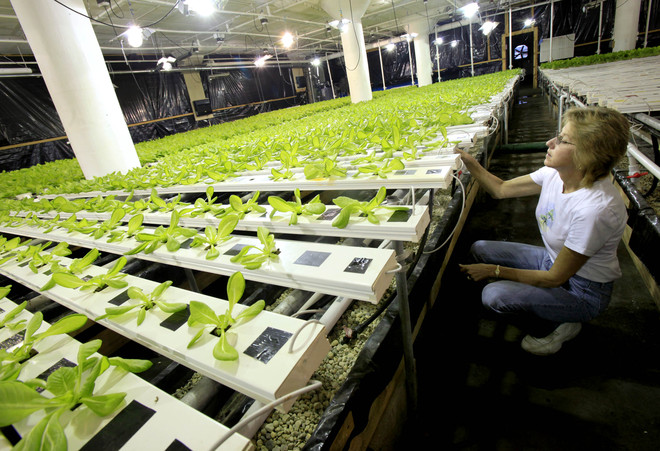
But local does not need to be rural.  Southeastern Wisconsin has two cool urban farms.  Check out these articles about Natural Green Farms built in an old industrial building in Racine and Growing Power in Milwaukee.

Urban Farm in Racine.

A five-story farm that Growing Power is considering building in Milwaukee.

I am attempting to build a collection of used/recycled/old/worn/vintage T-shirts to wear in my Natural Resources Law and Frontiers in Environmental Law & Policy classes this year.  I’m looking for T-shirts that have designs about parks, nature, environment, sustainability, local food, vegetarianism, small farming, agriculture, climate change, energy, organic, earth, local food restaurants or anything else that has some sort of ecologically positive message.  Please sift through you old T-shirts (size L or XL) and if you find one, please deliver it to my office, home, the softball field, or even mail it to the Vermont Law School.  While I’m offering no money, I will attribute the source to you and you can feel good about recycling your old shirts (and limiting my consumption of new ones).  Any shirts I don’t wear will be given to a clothing charity.

…and not because of a Nelly video.

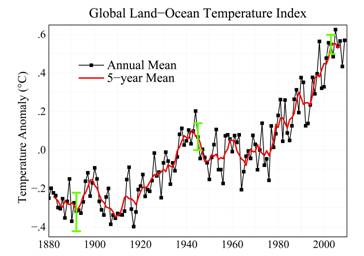
The NY Times Green Blog, citing NOAA, reports that “average global temperatures from April to June and from January to June were the highest ever recorded in those time periods.”

The graph below shows through the year 2009, the warmest years of the past century are 1998, 2002, 2003, 2004, 2005, 2006, 2007, and 2009.

Global Annual Mean Surface Air Temperature Change

Once again Prawfsblawg is compiling a list of Law School Faculty Hiring Chairs.

Vermont Law School is hiring this year.  Our Faculty Appointments Commitee (entry and lateral) is chaired by Michael McCann of sports law fame.  Other members of the Committee include Jason Czarnezki (me), Stephanie Farrior, Oliver Goodenough, Cheryl Hanna, Mark Latham, and Marc Mihaly.  If interested, please send an email with cover letter and CV to FacultySearch@vermontlaw.edu.