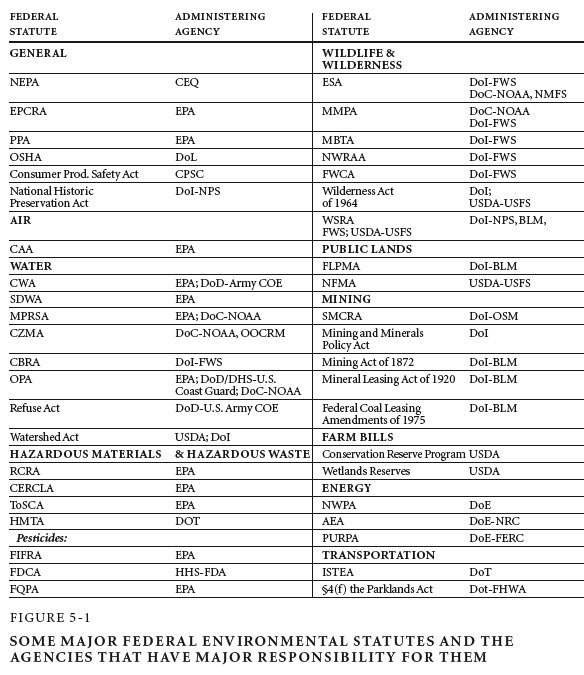
From the new, 4th edition of the Plater, Abrams,Graham, Heinzerling, Wirth & Hall casebook (Aspen).
September 20, 2010
From the new, 4th edition of the Plater, Abrams,Graham, Heinzerling, Wirth & Hall casebook (Aspen).
September 19, 2010
The NY Times has an article titled “Cleaner for the Environment, Not for the Dishes” about how green products, esepcially cleaning products, might be viewed by some consumers as not doing as well a job. I think the article adequately points out the benefits of less toxic products like better public health and less freshwater pollution. I think the article could go even further in exploring this statement: “Yet the new products can run up against longtime habits and even cultural concepts of cleanliness.”
September 17, 2010
I’m now just exhausted by Law School Rankings and the navel-gazing that is going on in the legal academy. First, let me point the finger at myself. I posted rankings and commentary on law school ranking when I ran the Empirical Legal Studies Blog, and have posted rankings on this blog when they promote Vermont Law School. Second, some information used in such rankings is necessary for prospective students and maybe faculty. Third, some self-promotion is useful and necessary to attract students, faculty, and scholarly readership. That’s why law schools make color-glossy viewbooks, faculty are interested in law review rankings, and law prof blogs are quite popular.
But now it’s simply gotten out of hand. There are so many lists–Law school and faculty scholarly rankings by U.S. News and World Report, Brian Leiter, Gregory Sisk, Gordon Hylton, Cooley Law School, Roger Williams Law, Princeton Review, SSRN, and a new one by Forbes. Did I miss anyone? (Note: I decline to provide links to these.)
Many of these rankings don’t provide the individualized information that any prospective students need. Or, perhaps better stated, do prospective students know how to interpret data that might be useful to them? E.g., if I go to “X Law School” will it help me get the type of job I want in the geographic location I desire? There are exceptions. As an example some data that I would have found useful, Leiter’s information on “Where Current Law Faculty Went to Law School” would be quite useful if you want to be a law professor.
This now leads me to the potential erosion of faculty scholarship, which is already under enough criticism. Here, I’ll pick on three friends and colleagues rather than people I don’t know (so they can simply and comfortably call me up and argue with me; though I’ll link to their work since ‘any PR is good PR’). Professor Gregory Sisk has written an article “Scholarly Impact of Law School Faculties: Extending the Leiter Rankings to the Top 70.” It’s received a gazillion SSRN hits (now more that I’ve linked to it), tons of blog commentary, and, I have little doubt, is high-end methodology given what I know about Greg’s other work. Similar, Paul Secunda wrote “Tales of a Law Professor Lateral Nothing.” Once again, if you write articles about rankings, faculty hiring, citation downloads, or degrees of separation from Cass Sunstein (here picking on my friend Tracey George, who is an absolute first rate scholar and methodologist), the blogosphere explodes, your citation counts increase, and your self-promotion is successful. I ask quite calmly and seriously ask, what is the goal of such work? And for what audience?
So here’s my point: We need to make rankings, to the extent they are created, useful for students, and be careful not to let legal educational structure be dictated by overall rankings as it may impair educational quality. Second, while we live in a self-promoting world, I think we need to have a thoughtful discussion about the goals and scholarly value of essentially ranking and writing about law professors.
UPDATE: It was just pointed pointed out to me that “if [my] blog post is taken seriously, that will just mean more SSRN articles about rankings!” True enough. I give up.
UPDATE 2: Another person pointed out to me: “If you hate law school rankings, and especially if you hate the U.S. News ranking, then you should wish for more law school rankings. Only by a proliferation of metrics and evaluations and surveys that address a diversity of law school characteristics and elements, allow each person to consider the individual rather than a conglomerated whole, will the U.S. News stranglehold on the law school ranks be broken. And each additional ranking has the effect of diluting the others, thus making each new addition less important and less powerful than what went before.”
September 16, 2010
A ballot initiative in California proposes to stop the state’s Global Warming Solutions Act (which proposes to reduce greenhouse gas levels to 1990 levels by 2020) from taking affect until unemployment falls significantly (to a point which has only been acheived 3 times in 4o years), likely killing the legislation. As this article makes clear, this ballot proposition is a dangerous mix of referendum politics, special interests, enormous contributions by oil companies, and exemplefies how environmentalism can take a back seat in very tough economic times.
UPDATE: Dan Farber at Legal Planet has an update on the national attention to Prop 23.
September 16, 2010
Click here for an announcement from the Environmental Law Institute, ABA Environment, Energy, and Resources Section, and NAELS regarding a student writing competition focusing on the intersection between constitutional and environmental law. The winning paper, and possibly a few honorable mentions, will be published in the Environmental Law Reporter. There is also a $2,000 cash prize and a one-year individual membership to ELI. The deadline for submissions is April 11, 2011.
September 16, 2010
Now that Peter Shumlin has been declared the Democratic nominee in the Vermont Governor’s Race, there has been a dramatic shift in the polling and statistical predictions of who will win the race. Interpret with caution.
Writes Nate Silver:
Another state with sparse polling is Vermont; Rasmussen Reports is the only firm to have surveyed the state, and only on a couple of occasions. But a new poll from Rasmussen shows the Democrat, Peter Shumlin, with a narrow lead, after previously having trailed the Republican Brian Dubie by a substantial margin. Mr. Shumlin was declared the winner of a recount in the Democratic primary last week, in which four Democrats each finished with 21 to 25 percent of the vote. Polling results can sometimes be erratic immediately before or immediately after primaries, and so the poll should probably be interpreted cautiously — although it is also not uncommon for a fundamentally new dynamic to emerge in a race after a primary. In any event, the model now regards Mr. Shumlin as a 3-to-1 favorite, in spite of having been the underdog before.
September 16, 2010
My friends and colleagues know I like to make political predictions. (Yes, I did, in public, predict that George W. Bush would nominate Harriet Miers to the Supreme Court. Recall that Dick Cheney, in charge of the VP committee, selected himself so there was precedent that I relied on). So I want to clearly state via the blog that, yes, I believe that Sarah Palin will run for President in 2012. I really want to predict that Palin will win the GOP nomination (and that would be my prediction if I had to make one today), but I don’t feel comfortable making this bold assertion until after the mid-term elections.
For support for my ‘she will run’ prediction see here. When you think there’s a change that you could be elected president and a buzz surrounds you, you usually go for it (see, e.g, Barack Obama).
UPDATE: It seems that I was on something. See here.
September 16, 2010
After I received an inquiry from a friend, I’ve been pondering the following question:
If someone is interested in what policies to pursue in the face of climate change and I could suggest only one very accessible piece to read, what would I choose?
I’ve started asking colleagues this question. Here’s in the beginning list:
Any additional suggestions? Please comment.
September 15, 2010
Call for Papers: Civil Litigation as a Tool for Regulating Climate Change
February 18, 2011
The purpose of this conference is to explore the interlinked policy, science, legal and political questions of utilizing the American litigation system, and particularly its tort theories of liability, to regulate climate change. Attempts to employ the courts as a tool for regulation are exemplified by cases such as Comer v. Murphy Oil, Connecticut v. American Electric Power, Co., and Native Village of Kivalina v. Exxon Mobile Corporation. Key presentations at the conference will be made by Professor Daniel Farber, Director of the Center for Law, Energy and the Environment, University of California at Berkeley; Professor Michael B. Gerrard, Director of the Center for Climate Change Law, Columbia University School of Law; and Professor Daniel Bodansky of the Schools of Sustainability and of Law, Arizona State University. Scholars and practitioners in the fields of environmental science, litigation, and tort law, among other areas, are encouraged to attend and present papers that will generate debate and discussion concerning the desirability of such litigation, strategies concerning it, and the impact it might have on efforts to bring about national legislation and international cooperation on global warming and related problems.
Valparaiso University School of Law issues this call for papers as part of the 25th Annual Monsanto Lecture/Conference on Tort Law and Jurisprudence, to be held at the School of Law on February 18, 2011. If you are interested in presenting, please submit an abstract of your proposed paper. Abstracts are due on or before December 1, 2010. A limited number of stipends are available to defray travel and lodging costs of some participants.
JoEllen Lind, Professor of Law and Associate Dean for Faculty Development, Joellen.Lind@valpo.edu
September 14, 2010
After a student in my Natural Resources Law class read Kleppe v. New Mexico, 426 U.S. 529 (1976), he alerted me to this article entitled Horse Advocates Pull for Underdogs in Roundups. If you’re interested in the Property Clause of the U.S. Consitution, animals rights, or the Wild Free-roaming Horses and Burros Act, check out the links.


 JASON J. CZARNEZKI