See here.  The Times’ Green Blog writes:

The newly appointed leader of a House subcommittee that controls the Environmental Protection Agency’s budget, Representative Mike Simpson, Republican of Idaho, says he intends to slash the agency’s funding. “The E.P.A. is the scariest agency in the federal government, an agency run amok,” Mr. Simpson said in a statement on Friday. “Its bloated budget has allowed it to drastically expand its regulatory authority in a way that is hurting our economy and pushing an unwanted government further into the lives of Idahoans.”

Over at Vermont2China, my partner has a great post on the future of Hong Kong.  See here.

It’s been a busy 6 six days, traveling from Hong Kong to San Francisco and now back to VT, so here’s a quick update.

On our last day in HK, I met with folks at WWF-HK about climate change policy, and very happily secured an annual internship there for a Vermont Law School student.

I then flew to SF for the AALS annual meeting which included the Environmental Law Field Trip to the Sacramento Delta which included discussion of wildlife preservation (while viewing the cranes), the bizarre water system, and The Nature Conservancy’s presence in the Delta for agricultural purposes (something I still find odd given that TNC uses pesticides and fertilizers).

(As an aside, I was unhappy with how AALS dealt with the labor dispute in SF, and I continue to be annoyed by all the waste at these conferences; free bags, name badges, etc.)

I enjoyed seeing Golden Gate Park in SF, don’t understand why SanFranciscans must wait in line for trendy restaurants (didn’t want to wait for Burma Superstar this time around, but did wait for The Slanted Door) but truly enjoyed a quick trip to Muir Woods National Monument. The Redwoods are simply beautiful, and the tallest living thing on Earth.

Finished reading Slow Death by Rubber Duck on the plane, and started reading Game Change.

…asks this NY Times article.

Today, Vermont Law School’s Environmental Law Center launched its first annual Top 10 Environmental Watch List. Our environmental faculty and students from the Vermont Journal of Environmental Law researched more than 75 judicial, regulatory, and legislative actions before selecting what they consider the 10 most important environmental law and policy issues of 2010.   Read more at http://watchlist.vermontlaw.edu/.

With a student, I co-authored the article for No. 8 on the list, Supreme Court Reviews Genetically Modified Crops.

ELI Diversity Program Law Clerk
Summer 2011

In partnership with Pfizer Inc, Beveridge & Diamond PC, and the American Bar Association Section on Environment, Energy, and Resources, the Environmental Law Institute (ELI) seeks applications from law students for two Diversity Program Law Clerk positions. The program’s goal is to encourage additional participation by minority students and students from disadvantaged households in environmental law, policy, and management.

For three decades, ELI has played a pivotal role in shaping the fields of environmental law, policy, and management, both domestically and internationally. ELI’s mission is to protect the environment by improving law, policy, and management. For more information visit .

Law clerks will work on projects involving both domestic and international environmental law. Subject areas include, among others, wetlands and watershed policy, sustainable land use, biodiversity, environmental enforcement, long-term management of hazardous sites, public participation, and international environmental policy. Law clerks conduct legal and policy research, conduct interviews, attend and report on events, and prepare written materials and scholarly work for publication. Part of the summer experience includes opportunities to attend seminars put on by ELI for law students and lawyers.

Law clerks may also assist with the editing and production of ELI’s publications, the Environmental Law Reporter (ELR), the National Wetlands Newsletter (NWN), and The Environmental Forum (TEF), as well as various books. Law clerks support editors of these periodicals by conducting research, bluebooking, monitoring and writing summaries of current events, and engaging in various tasks and special projects on an as-needed basis.

Qualifications: (1) superior research and writing skills; (2) strong academic performance; and (3) strong communication skills. Only students currently enrolled in law school are eligible to apply. Students who will have completed their second year of law school are preferred, though first-year students will also be considered.

Stipend: Diversity law clerks will be paid $5,000 for the summer.

To Apply: Interested candidates should submit a cover letter, resume, list of references, law school transcript, college and law school GPAs, and writing sample. Cover letters should address the candidates’ personal goals and interests, as well as their experience and interest in environmental law and policy. They should also state how candidates will contribute to the diversity of the environmental law, management, and policy field. Application materials should be submitted to: law. We have extended the deadline for applications for summer 2011 to January 31, 2011.

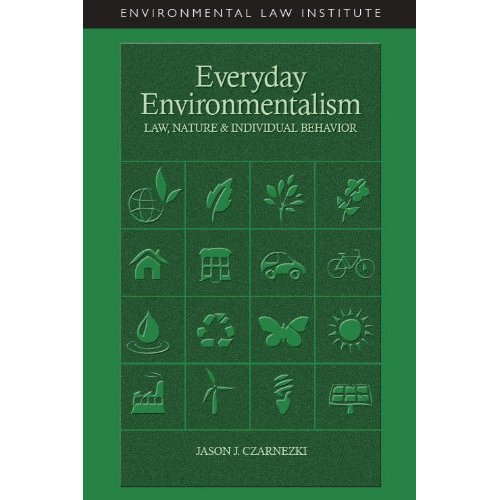
Sometime in 2006 I thought about writing a book, and in early 2007 I thought maybe this was a good idea.  In summer 2007, I wrote a book prospectus.  This month my first book will be published.  And now today, I am just shocked, almost 4 years later, to actually see you can pre-order (!!!) my book on Amazon.com.  Click here.  It’s titled, “Everyday Environmentalism: Law, Nature, and Individual Behavior.”  Here’s the product description:

Faced with the seemingly overwhelming prospect of global climate change and its consequences, is there anything that a person can do to make a difference? “Yes, there is!” says Jason Czarnezki. Writing as a lawyer and environmentalist, he addresses the small personal choices that individuals can make in order to have a positive effect on the natural world.  Czarnezki compellingly describes the historical and contemporary forces in the United States that have led to a culture of “convenience, consumerism, and consumption.” He also investigates the individual decisions that have the worst environmental impacts, along with the ecological costs of our food choices and the environmental costs of sprawl.  Ever aware of the importance of personal choice, Czarnezki offers a thoughtful consideration of how public policy can positively affect individual behavior.

After two weeks in China, we’ve returned to Hong Kong. In my two days here, I’ll be meeting with folks at WWF-Hong Kong and the Hong Kong Environmental Protection Department. At WWF, I’m meeting with their climate programme team, and I’m curious to learn more about the HKEPD’s relationship with the Chinese national government in Beijing given Hong Kong’s unique status. (At both meetings I hope to explore potential internship opportunities for Vermont Law School students.)

In other news, the LLM Fellow in the China Program at Vermont Law School has a nice blog post on China and U.S. coal addiction.

This morning I attended two Vermont Law School – Sun Yat-sen University Collaborative Research Presentations held on campus in Guangzhou. The first paper was entitled “Promoting Green Jobs Through Wind Energy: A Comparison of U.S. and China Policies.” Their key research goal was a comparative analysis of US and Chinese law in the development of renewable energy, especially wind, and the emerging market for “green jobs” (a term they sought to define). The second paper was “The Resurrection of Water: Guangdong’s Pollution Permitting System,” which compared environmental impact assessment and water permitting regimes in the two countries. Following the presentation, we had lunch with Chinese students and faculty, and then I took my Vermont Law students on a campus tour and the local market.

See here.