Rick Frank over a Legal Planet has a nice post entitled “Preview of Coming Attractions: American Electric Power v. State of Connecticut.” It begins:

The U.S. Supreme Court recently announced the scheduling of oral arguments in the biggest (actually, the only) environmental case of its current Term: American Electric Power v. State of Connecticut. The justices will hear arguments on April 19th, and render their decision in this major climate change case by the end of June. Already, however, some interesting factoids and subplots have developed.

This case raises three distinct legal questions of interest to climate change mavens and environmental lawyers and academics generally: 1) whether the states and private land trusts that have brought this public nuisance action against the owners of Midwestern coal-fired power plants have standing to sue; 2) whether the federal common law of nuisance remains a viable legal theory in the climate change litigation arsenal or, instead, common law nuisance claims have been displaced by federal environmental statutes; and 3) whether plaintiffs’ efforts to invoke public nuisance law to address the climate change impacts of greenhouse gas emissions from defendants’ power plants constitute a non-justiciable “political question.”
The Environmental Law Section of the State Bar of Michigan is pleased to announce its tenth annual Environmental Law Essay Contest, with cash prizes of $2,000 for first place, $1,000 for second place, and $500 for third place.  The contest is open to all students in any law school in the United States or Canada.  Entries must be submitted by June 30, 2011, so there is plenty of time to research and write a winning essay.

More details here.

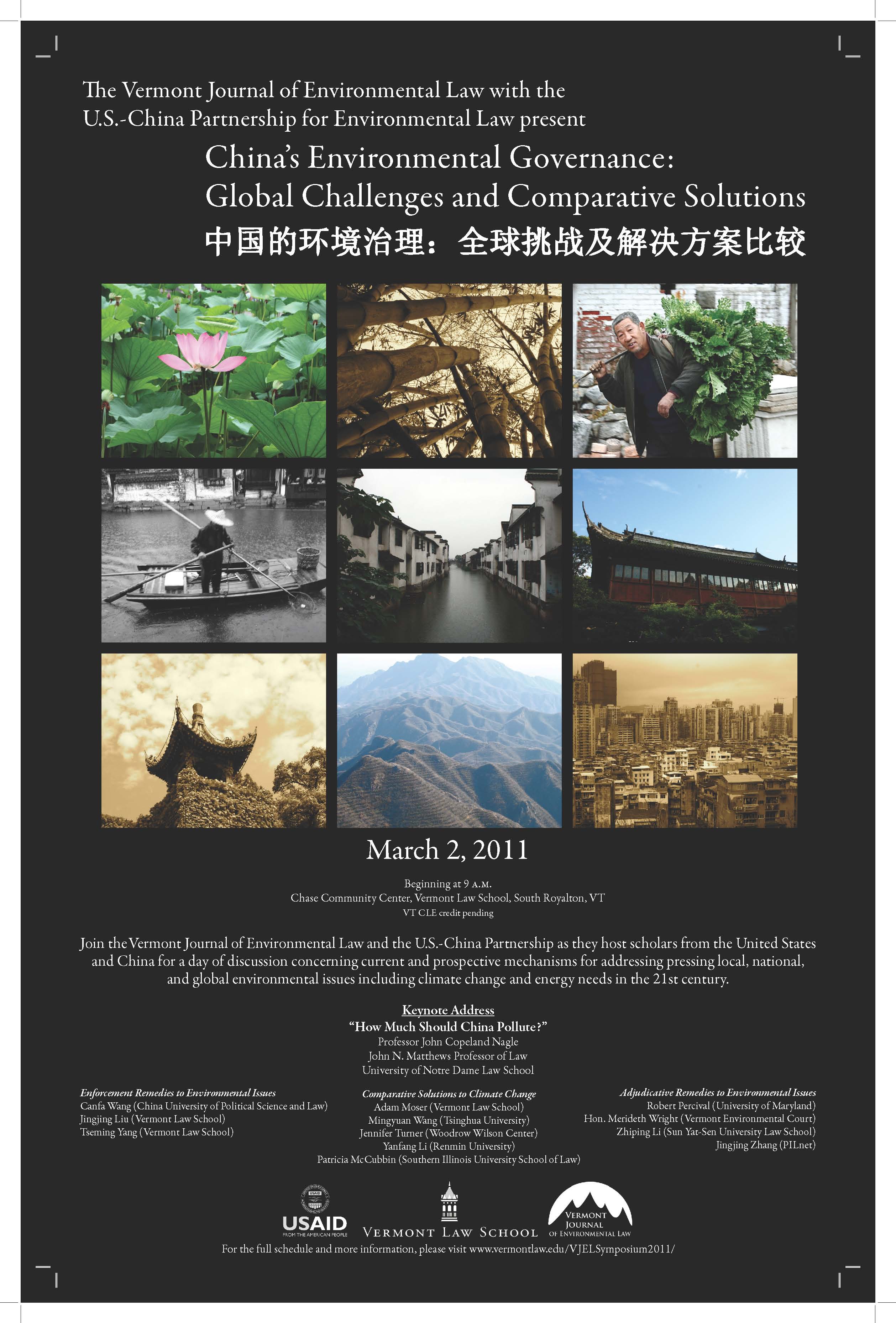
The Vermont Journal of Environmental Law with the U.S.-China Partnership for Environmental Law present
China’s Environmental Governance: Global Challenges and Comparative Solutions

An interesting article in High Country News about the barriers to having small farms compete with corporate giants: Small poultry farmers grapple with lack of slaughterhouses.

Over at The Faculty Lounge, they’ve decided to rank the “Most Productive Environmental Law Scholars 2005-2009 at “Top” Environmental Schools.”  (It seems I’m #7.)

I can’t.  I couldn’t do it.  So regardless of what you think of Justice Thomas and his silence, it’s borderline amazing that he can go 5 (!) years without saying anything at oral argument.

I’ve been thinking a lot about the power of social movements to create environmental change.  I know many sociologists and political scientists have studied grassroots environmentalism as a way to generate political change, but in the U.S., major environmental legislation hasn’t been passed for decades yet some sort of local environmental social movement is afoot as it relates to food.  People are genuinely interested in local and organic foods, regional food systems, composting, and universities are creating food-related programs.  While I think many of these positives have yet to fully address the problem of making alternative agriculture affordable, food is the most initimate natural resource we all use and perhaps can be a facilatator for a greater environmental movement.

http://www.nytimes.com/2011/02/10/science/earth/10fish.html?_r=1&ref=us

I’m a proponent of eco-labeling, but concerns about greenwashing and certification processes are very valid. Now there is a lawsuit against S.C. Johnson because they are certifying their own products as “green.” This article states, “Litigation pending in federal court in California and Wisconsin contends that S.C. Johnson is deceptively implying that Windex and Shout have been tested by a neutral third party and been found to be environmentally friendly.”

One of my property students send me the following email:

Dear Professor Czarnezki,
I heard an interesting piece on npr today regarding property rights. The Mardi Gras Indians are seeking to protect the profitability of their elaborate costuming, and "filing for copyright protection."
http://www.npr.org/2011/02/08/133600362/Mardi-Gras-Indians-Seek-To-Copyright-Costumes
Best,
[Student Name]

We just read INS v. AP, and Cheney Brothers v. Doris Silk in class, so the students are interested in cases about folks trying to protect the fruits of their labor.