August 2010
Monthly Archive
August 8, 2010
Posted by Jason J. Czarnezki under
Energy,
Environment
Leave a Comment
There’s an interesting Op-Ed in my local paper entitled “Energy Efficiency is Not About the Windows,” making the argument that energy efficiency in the home is about sealing up the home and cracks around the windows. To me this raises, a broader question: What are the most energy inefficient structures in my community, and how are the best “low-hanging fruit” for energy efficiency in my own home?
For my own home, home energy-audits are available (often subsidized) and turning down the thermostat and hot water temperatures are good starts. But the community at large is a more dififcult query, since resources should be allocated to the largest energy hogs. While on the Montpelier Planning Commission before we left for China, we learned there were funds available to potentially do a large-scale energy efficiency project in town. Most people on the Commission wanted to do a singular big project. I argued that we should identify the most energy inefficient structures in the community, make them efficient, and spread the cost saving to the entire community. My proposal was simply not sexy enough, and gained little traction. I find it unfortuante that low cost – high benefit envioronmental choices often receive so little play (e.g., chaulking your windows and home weatherization), but the big ticket items (e.g., new windows or biomass plants) seem to get everyone so excited. What’s wrong with a little cost-benefit analysis?
August 7, 2010
Posted by Jason J. Czarnezki under
Law,
Supreme Court
1 Comment
Most Americans cannot name a single member of the Supreme Court of the United States (SCOTUS) (according to a 2006 Findlaw.com survey), and in my experience (and yes, I’ve done pop quizzes) most law students cannot name all 9 members of the SCOTUS, which has actually become more difficult following the consistency of the Rehnquist Court. So in an effort to help my students and with today’s swearing in of Elena Kagan, the current nine members of the Supreme Court are:
Chief Justice John Roberts, and Associate Justices Antonin Scalia, Anthony Kennedy, Clarence Thomas, Ruth Bader Ginsburg, Stephen Breyer, Samuel Alito, Sonia Sotomayor, and Elena Kagan.
But lists are boring so here are some predictions, some more bold than others:
(1) Justice Ginsburg’s seat will be the next vacancy on the Court.
(2) Scalia’s seat will be the next to open after Ginsburg’s, causing extensive media and public interest.
(3) Identity politics will continue to play a major role in the nomination process (first Asian-American on the Court?)…..
(4) …..But age (or, better stated, youth) will trump and the next nominee will be born in 1955 or later.
(5) We will see 4 woman on the Supreme Court no later than 2017.
August 6, 2010
Many are aware of the threat of climate change to polar bears due to melting Arctic sea ice, but Greenwire reports that polar bears are also at risk from chemicals previously frozen within the ice. The report:
Polar bears are not just facing the threat of climate change. They must also contend with pollutant chemicals that are not breaking down in cold Arctic water, according to a new study.
The study, published in the journal Science of the Total Environment, reports that sea ice is receding and could expose species such as polar bears to organic pollutants, including flame-retardants and materials used in plastics. The chemicals can be locked into ice for decades and released as it melts due to rising temperatures.
“These contaminants are bio-accumulated and bio-magnified up the food chain. So the higher you are, the higher the contaminants,” said Bjørn Munro Jenssen, one of the study’s co-authors.
Munro Jenssen, an eco-toxicologist at the Norwegian University of Science and Technology, said polar bears are especially at risk because they eat seals, which can store the chemicals in their fat. According to the study, the chemicals can affect the bears’ immune systems and mimic hormones. Some bears have even changed genders because of the chemicals.
August 5, 2010
Posted by Jason J. Czarnezki under
Announcements
Leave a Comment
Click here for the Fall 2010 Call for Papers for Sustainable Development Law & Policy, a publication of American University Washington College of Law. The Issue is titled “Sustainable Development in the Urban Environment.”
August 5, 2010
Posted by Jason J. Czarnezki under
China,
Environment
Leave a Comment
After a year in China, one learns to accept and understand many things about the Chinese government–it has access to a huge labor force in the event of a natural disaster or major event (recall the Olympic opening ceremony); that public image is very important; that ecnomic growth is paramount; that techonological expertise is variable; and that there always seem to be alternative accounts of any major story. The NY Times has published one story, “Worker’s Question China’s Account of Oil Spill,” that touches on all of these characteristics. I have no clue which account of the oil spill is correct, but neither version would surprise me.
August 3, 2010
After we’ve only been back from China for less than two months, I’m amazed that my friend and colleague David Mears and his family are off to China for their Fulbright experience at Sun Yat-sen University in Guangzhou. David has started a blog–Middle Earth Law. In Chinese, China is “Zhong Guo” or “Middle Kingdom/Country.”
He desribes the goals of his blog this way:
“Middle Earth Law” is my effort to capture three themes that I hope to address over the coming year on this page: (1) my adventure to a strange and wonderful far away land; (2) my effort to understand the state of the ecology of China, its landscapes and natural systems; and (3) my examination of the way in which law is being used or could be used to address the major environmental challenges confronting the People’s Republic of China as it copes with the consequences of its rapid economic expansion.
For folks still interested in my family’s Fulbright experince, our old blog Vermont2China is still up.
August 2, 2010
Reports the NY Times here.
August 2, 2010
We live in Montpelier, Vermont, and my partner is from Peaks Island, Maine. When traveling between the two, it is clear that we are spoiled by the nature of New England. From my backyard, I can see Camel’s Hump and the Green Mountains. Driving east via Route 2, we drive past Groton State Forest, and into New Hampshire’s White Mountain National Forest where we recently saw a large black bear just west of Gorham, NH. After following the lakes and rivers of Western Maine, we arrive at Portland’s Casco Bay for the ferry to Peaks Island.
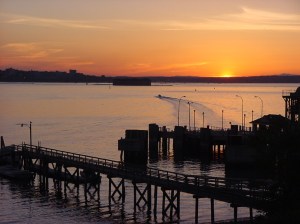
Sunset from Peaks Island
August 1, 2010
Posted by Jason J. Czarnezki under
Law Schools
Leave a Comment
I just posted that Vermont Law School is hiring this year, and PrawfsBlawg is compiling a list of this year’s hiring chairs, but I want to know who is hiring in environmental and natural resources law specifically. Given the Vermont Law School’s #1 ranking in environmental law, we’re often solicited for suggestions by folks at other schools about potential environmental law candidates, and we know many candidates who are in search of environmental law academic positions.
Thus, law school hiring committee members, please announce your available positions in the comments if you are considering hiring in the areas of environmental and/or natural respources law. Please also feel free to share who else is on your hiring committee.
« Previous Page


 JASON J. CZARNEZKI