When I was in China, my Chinese students and colleagues never wanted to recognize that their country would soon surpass Japan as the second-largest economy in the world. This inevitability is now a reality, as reported today. While culturally the Chinese are not ones to take credit, from an imternational relations and foreign policy standpoint, the country is somehwhat weary of this status. With such economic prowess, it is much harder to limit international obligation and responsibility, especially when those arguments often rest on the the lack of economic prosperity for much of the country. While the vast majority of Chinese are most certainly poor, the Chinese recognize their growing status in the world and the Chinese government will want to continue to be seen as a global power. Thus, the time is now for the U.S. become a real global leader on environmental issues because the Chinese are perceived as economic superpowers, and the failure to join the U.S. in a leadership role could be seen as embarrassing. Now is the time for the U.S. to lead and challenge the Chinese to be more than leader of the developing world, which is often the fall back description of their country. China and the U.S. are the two largest emitters of greenhouse emissions, and both need to act. Unfortunately, U.S. domestic and international policy has failed in terms of environmental and economic policies to help improve international carbon emissions and pollution due manufacturing in the developing world. The constructive critism of U.S. policy can be spread around–the U.S. Senate, the President at Copenhagen, American consumption patterns, the interstate highway system, etc.
Politics
August 16, 2010
And so it begins…China is World’s Second Largest Econony
Posted by Jason J. Czarnezki under China, Climate Change, Environment, PoliticsLeave a Comment
August 16, 2010
Vermont Governor Race & the Environment
Posted by Jason J. Czarnezki under Environment, PoliticsLeave a Comment
The Time Argus has posted this article about the candidates and their environmental views.
August 14, 2010
Perry v. Schwarzenegger: Will Same-sex Couples in CA Start Getting Married?
Posted by Jason J. Czarnezki under Law, PoliticsLeave a Comment
In case you haven’t been following, a federal court in California overturned the state’s ban on gay marriage as violating the 14th Amendment of the U.S. Constitution. The court stated:
Proposition 8 fails to advance any rational basis in singling out gay men and lesbians for denial of a marriage license. Indeed, the evidence shows Proposition 8 does nothing more than enshrine in the California Constitution the notion that opposite sex couples are superior to same-sex couples. Because California has no interest in discriminating against gay men and lesbians, and because Proposition 8 prevents California from fulfilling its constitutional obligation to provide marriages on an equal basis, the court concludes that Proposition 8 is unconstitutional.
“Rational basis” is a legal term of art. Since marriage is a fundamental right, the government bears the burden of proving that Prop 8 is narrowly tailored to meet a compelling state interest (i.e. strict scrutiny). The lower court found that Prop 8 could not even survive rational basis review (a lower form of evaluation), let alone strict scrutiny. The court opinion in full can be found here.
The plaintiffs’ case was argued by David Boies and Ted Olson, ideological opposites who were the attorneys in the 2000 Supreme Court battle Bush v. Gore which decided the Presidency. And, of note, Ted Olson was the Solicitor General under President George W. Bush. What makes this fact so fascinating is that this case could ultimately be decided by the U.S. Supreme Court.
Now the question seems to be whether same-sex couples can begin getting married immediately or whether the decision of the district court should be stayed until the Ninth Citucit can rule. It is both an interesting case in terms of substantive constitutional law, and now civil procedure. My University of Chicago law school classmate, Dan Powell, former clerk to Supreme Court Justice John Paul Stevens and now Deputy Attorney General of California, just filed with the Ninth Circuit the CA AG’s Opposition to the Emergency Motion for Stay Pending Appeal. In terms of the stay, the California Attorney General’s Office is arguing that same-sex couples should be allowed to marry immediately since while there may be administrative burdens if the marriages are later declared invalid, these burdens are outweighed by the district court’s conclusion that a constitutional violation is occuring.
August 11, 2010
We are witnessing the demise of American politics, and the end of politicians who can win a race on hard work alone. With the Supreme Court’s decision in Citizen United that removed restraints on corporations from financing federal political campaigns, the huge increase in spending in state judicial campaigns (which also harms judicial independence), and the astronomical somes of money being spent in statewide races, the politician that goes door-to-door, wins on ideas alone, and trys to meet people and build relationships is slowing departing the American political scene, unless he or she has a lot of financial backing to boot. The President of the United States, Democrat Barack Obama, did not accept spending limits and federal financing during the 2008 election, and the NY Times reports that, in an effort to be the U.S. Senator from Connecticut, former World Wrestling Executive Linda McMahon spent $22 million to win yesterday’s Republican primary and is willing to spend an additional $28 million to defeat her Democrat opponent, Attorney General Richard Blumenthal, in the general election. Legal issues surrounding the First Amendment aside, it is a sad day when money rather than ideas drive the political future of our country.
July 30, 2010
When Politics and the Environment Converge, Unique Quotes Happen
Posted by Jason J. Czarnezki under Environment, PoliticsLeave a Comment
Via Political Wire’s Quote of the Day:
“I think they should name it something better. The top ends up flatter, but we’re not talking about Mount Everest. We’re talking about these little knobby hills that are everywhere out here.”
— Kentucky U.S. Senate candidate Rand Paul (R), in an interview with Details magazine, on mountain top removal coal mining, noting many people “would say the land is of enhanced value, because now you can build on it.”
July 29, 2010
The Climate Debate and Its Problems
Posted by Jason J. Czarnezki under Climate Change, Environment, Law, Politics[2] Comments
In a 2003 issue of Science magazine, Tulane Law School Professor Oliver Houck wrote about the troubled marriage between law and science. Simply put, law seeks certainty and rules, while science deals with nuanced and complex data that is far from absolute.
Climate chage now is arguably more a political issue than a legal or scientific one, at least to the extent nations struggle with whether they should regulate carbon. In my College Magazine of the University of Chicago, The Core, I came across the winning essay of the John Crear Foundation Science Writing Prize for College Students entitled “Karl Popper and Antartic Ice: The Climate Debate and Its Problems.” It is certainly worth a read for it illustrates that difficulty that politics (as law) have in dealing with science.
July 25, 2010
Should the Democrats Have Filibustered Justice Alito?
Posted by Jason J. Czarnezki under Law, Politics1 Comment
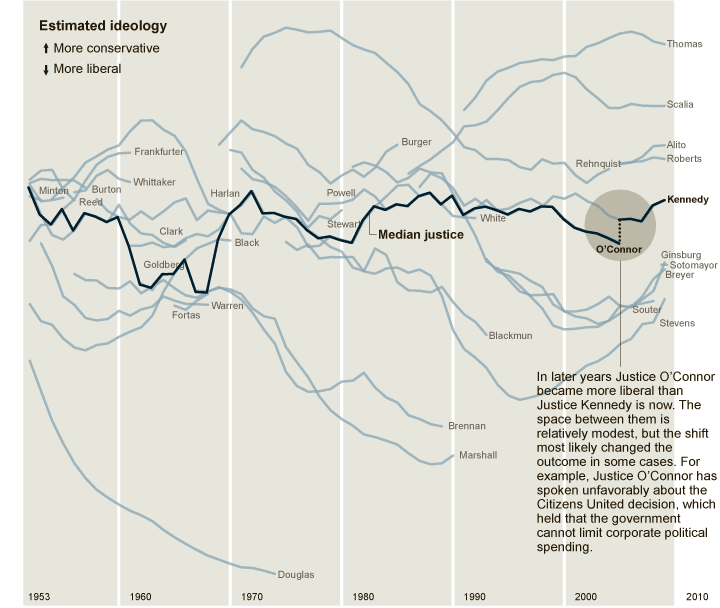
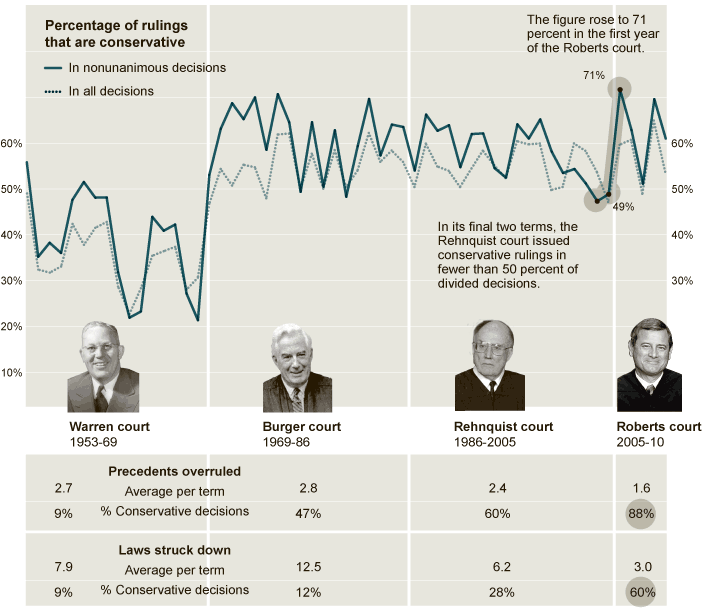
There are two flavors of judicial activism in the U.S. Supreme Court — liberal (e.g., the Warren Court) and conservative (e.g., the current Roberts Court). The NY Times today has an article titled “Court Under Roberts Is Most Conservative in Decades.” This is primarily due to the replacement of Justice Sandra Day O’Connor with Justice Samuel Alito.
A confluence of factors brought Justice Alito to the Court: the failure of the Harriet Miers nomination; the justices’ desire not to have two vacancies on the Court at once coupled with Rehnquist’s desire to hang on and O’Connor’s willingness to resign; the poor health of O’Connor’s husband; Rehnquist’s death.
With Alito replacing O’Connor, the Court has moved further to the right, and the data back this up (though I think how much to the right still remains to be seen). Readers of my former Empirical Legal Studies Blog will be pleased to see that the NY Times cites and uses data from Martin-Quinn Justice Scores, as well as data from Lee Epstein and Harold Spaeth.
Justice Alito was confirmed by a Senate vote of 58-42 (the second lowest vote total in history behind Clarence Thomas). The Democrats could have mustered a filibuster. Should they have? In purely political terms, yes. That said, the next question is a far more difficult one: Should otherwise qualified jurists be kept of the court for political reasons? This depends on one’s view of the role of the Court and the role of the Senate.
(Source of graphics: NY Times, http://www.nytimes.com/interactive/2010/07/25/us/20100725-roberts-graphic.html?ref=us)
July 23, 2010
Is Kerry Overly Optimistic on Climate Change Legislation?
Posted by Jason J. Czarnezki under Climate Change, Environment, Law, PoliticsLeave a Comment
Via Politico Playbook:
THE AGENDA — “Kerry Says Democrats May Take Broad Climate Bill After Election,” by Bloomberg’s Lisa Lerer and Viola Gienger: “Senator John Kerry said Democrats may take up his comprehensive climate-change bill in a lame-duck session after the November elections, while calling on President Barack Obama to escalate his advocacy for the measure. Senate Majority Leader Harry Reid yesterday introduced a more limited energy bill that doesn’t include a cap on greenhouse gas emissions, citing the lack of support for a broader bill. The bigger measure ‘is not dead,’ Kerry said in an interview on Bloomberg Television’s ‘Political Capital With Al Hunt.’ ‘If it is after the election, it may well be that some members are free and liberated and feeling that they can take a risk or do something.’”


 JASON J. CZARNEZKI