Law


I was a law clerk at the Wisconsin Department of Natural Resources (WDNR) right after the U.S. Supreme Court decided the case U.S. Army Corps of Engineers v. Solid Waste Agency of Northern Cook County (known as SWANCC).  In an interpretation of the Clean Water Act, the case stripped the federal government of its jurisdiction over many wetlands in the United States, leaving them subject to development and fill.  Wisconsin decided to assert state jurisdiction over these wetlands no longer subject to federal jurisdiction, and I helped to play a role drafting the administrative code that implemented the new Wisconsin Statute (2001 WI Act 6).

While Wisonsin has had a fairly progressive tradition in protecting wetlands, the struggle has been in getting other states to protect wetlands.  (See this article.)  My former colleague at WDNR just sent me info on a program from the Wisconsin Wetland Association that seeks to raise awareness about the importance of wetlands.  Called “Wetlands Gems,” they’ve published an awesome book that beautifully identifies and describes that best wetlands in Wisconsin.  I think other states would be smart to compile similar books.

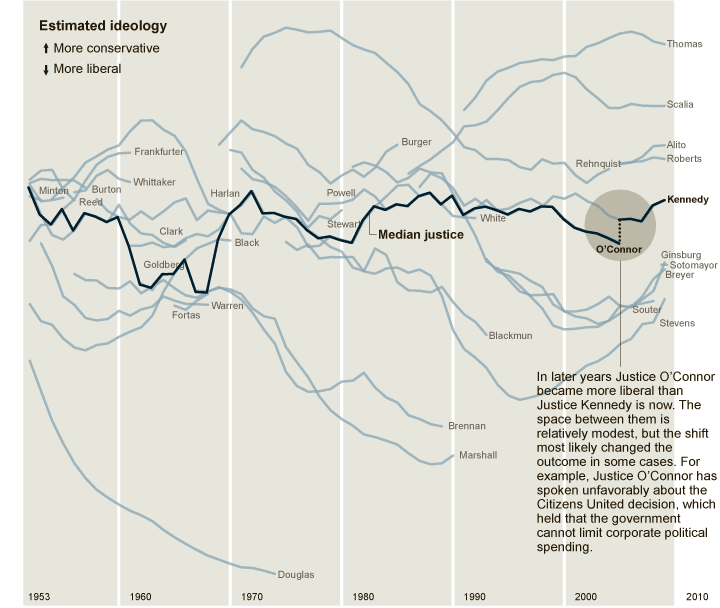
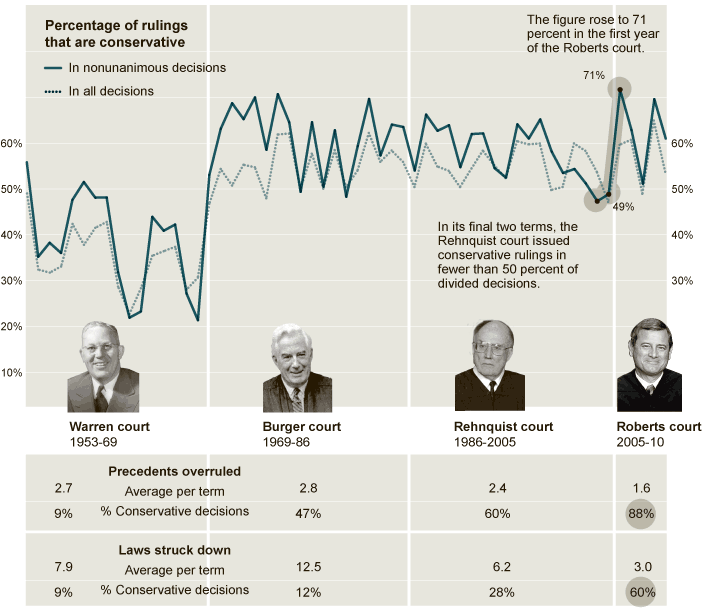
There are two flavors of judicial activism in the U.S. Supreme Court — liberal (e.g., the Warren Court) and conservative (e.g., the current Roberts Court).  The NY Times today has an article titled “Court Under Roberts Is Most Conservative in Decades.”  This is primarily due to the replacement of Justice Sandra Day O’Connor with Justice Samuel Alito.

A confluence of factors brought Justice Alito to the Court: the failure of the Harriet Miers nomination; the justices’ desire not to have two vacancies on the Court at once coupled with Rehnquist’s desire to hang on and O’Connor’s willingness to resign; the poor health of O’Connor’s husband; Rehnquist’s death.

With Alito replacing O’Connor, the Court has moved further to the right, and the data back this up (though I think how much to the right still remains to be seen).  Readers  of my former Empirical Legal Studies Blog will be pleased to see that the NY Times cites and uses data from Martin-Quinn Justice Scores, as well as data from Lee Epstein and Harold Spaeth.

Justice Alito was confirmed by a Senate vote of 58-42 (the second lowest vote total in history behind Clarence Thomas).  The Democrats could have mustered a filibuster.  Should they have?  In purely political terms, yes.  That  said, the next question is a far more difficult one: Should otherwise qualified jurists be kept of the court for political reasons?  This depends on one’s view of the role of the Court and the role of the Senate.

(Source of graphics: NY Times, http://www.nytimes.com/interactive/2010/07/25/us/20100725-roberts-graphic.html?ref=us)

I’m watching the movie Food Inc. while writing this post.  The movie provides more examples of how America’s industrial food system is bad for both human health and environmental health.

Part of the movie discusses “Kevin’s Law,” H.R. 3160, a bill that never became law that would give the USDA greater authority to regulate the meat and poultry industry to help stop the spread of pathogens that result from CAFOs (concentrated animal feed operations) and factory processing.

The Farm Bill also plays a role in impacting American’s diet by subsidizing the production of cheap commodity grain like corn.  This means that industrially produced food, fast food, and snack foods are often cheaper than fresh fruits and vegetables.  If you’re interested in learning more, read the articles Corn, Carbon and Conservation: Rethinking U.S. Agricultural Policy in a Changing Global Environment by Florida Law Professor Mary Jane Angelo and Paying the Farm Bill: How One Statute Has Radically Degraded the Natural Environment and How a Newfound Emphasis on Sustainability is the Key to Reviving the Ecosystem by Bill Eubanks.

If academic articles are not to your taste, try reading The Omnivore’s Dilemma by Michael Pollan.

Via Politico Playbook:

THE AGENDA — “Kerry Says Democrats May Take Broad Climate Bill After Election,” by Bloomberg’s Lisa Lerer and Viola Gienger: “Senator John Kerry said Democrats may take up his comprehensive climate-change bill in a lame-duck session after the November elections, while calling on President Barack Obama to escalate his advocacy for the measure. Senate Majority Leader Harry Reid yesterday introduced a more limited energy bill that doesn’t include a cap on greenhouse gas emissions, citing the lack of support for a broader bill. The bigger measure ‘is not dead,’ Kerry said in an interview on Bloomberg Television’s ‘Political Capital With Al Hunt.’ ‘If it is after the election, it may well be that some members are free and liberated and feeling that they can take a risk or do something.’”


Reports Political WireSenate Democrats said they “had abandoned hope of passing a comprehensive energy bill this summer and would pursue a more limited measure focused primarily on responding the Gulf oil spill and including some tightening of energy efficiency standards,” the New York Times reports.  Explained Senate Majority Leader Harry Reid: “We don’t have a single Republican to work with us.

The question I have is whether this is a good or bad thing.  Absent Congressional legislation, pursuant to the Supreme Court case of Mass. v. EPA, and in light of the EPA’s “endangerment finding” under the Clean Air Act that identifies greenhouses gases as an air pollutant, EPA regulation of carbon dioxide under the Clean Air Act could, if the Obama administration chooses to push it, be far more environmentally successful than any climate change legislation that passes Congress.  But how far is Obama willing to go?

I’ve started reading “Slow Food Nation: Why Our Food Should be Good, Clean, and Fair” by Carlo Pertrini.  In the Forward by Alice Waters, she writes, “We soon discovered that the best-tasting food came from local farmers, ranchers, and foragers, and fisherman who were committed to should in sustainable practices.”

More most be done to promote a local organic food system.  I am working on an article now discussing how law both impedes and can help facilitate such a market.  Not only does local chem-free food taste better, but it limits the environmental costs of food consumption.

Food choices can contribute to the climate crisis, cause species loss, impair water and air quality, and accelerate land use degradation.   For example, an estimated 25 percent of the emissions produced by people in industrialized nations can be traced to the food they eat.   The causes of these environmental costs are many—the livestock industry, a processed and meat-heavy diet, agricultural practices like pesticides and fertilization, and fossil-fuel intensive food transportation, factory processing, packaging and large-scale distribution systems.  These are traits of the dominant industrial food model.

If you teach statutory interpretation principles in any course, I offer up my favorite Supreme Court case: Nix v. Hedden (U.S. Supreme Court, 1893)

It asks an intriguing question – Is a tomato a fruit or a vegetable?

The full opinion follows (yes, it’s very short).

Nix v. Hedden, 149 U.S. 304 (1893)

MR. JUSTICE GRAY, after stating the case, delivered the opinion of the court.

The single question in this case is whether tomatoes, considered as provisions, are to be classed as “vegetables” or as “fruit,” within the meaning of the Tariff Act of 1883.

The only witnesses called at the trial testified that neither “vegetables” nor “fruit” had any special meaning in trade or commerce, different from that given in the dictionaries; and that they had the same meaning in trade to-day that they had in March 1883.

The passages cited from the dictionaries define the word “fruit” as the seed of plants, or that part of plants which contains the seed, and especially the juicy, pulpy products of certain plants, covering and containing the seed. These definitions have no tendency to show that tomatoes are “fruit,” as distinguished from “vegetables,” in common speech, or within the meaning of the Tariff Act.

There being no evidence that the words “fruit” and “vegetables” have acquired any special meaning in trade or commerce, they must receive their ordinary meaning.  Of that meaning the court is bound to take judicial notice, as it does in regard to all words in our own tongue; and upon such a question dictionaries are admitted, not as evidence, but only as aids to the memory and understanding of the court. Brown v. Piper, 91 U.S. 37, 42; Jones v. United States, 137 U.S. 202, 216; Nelson v. Cushing, 2 Cush. 519, 532, 533; Page v. Fawcet, 1 Leon. 242; Taylor on Evidence, (8th ed.) §§ 16, 21.

Botanically speaking, tomatoes are the fruit of a vine, just as are cucumbers, squashes, beans and peas. But in the common language of the people, whether sellers or consumers of provisions, all these are vegetables, which are grown in kitchen gardens, and which, whether eaten cooked or raw, are, like potatoes, carrots, parsnips, turnips, beets, cauliflower, cabbage, celery and lettuce, usually served at dinner in, with or after the soup, fish or meats which constitute the principal part of the repast, and not, like fruits generally, as dessert.

The attempt to class tomatoes with fruit is not unlike a recent attempt to class beans as seeds, of which Mr. Justice Bradley, speaking for this court, said: “We do not see why they should be classified as seeds, any more than walnuts should be so classified. Both are seeds in the language of botany or natural history, but not in commerce nor in common parlance. On the other hand, in speaking generally of provisions, beans may well be included under the term ‘vegetables.’ As an article of food on our tables, whether baked or boiled, or forming the basis of soup, they are used as a vegetable, as well when ripe as when green. This is the principal use to which they are put. Beyond the common knowledge which we have on this subject, very little evidence is necessary, or can be produced.” Robertson v. Salomon, 130 U.S. 412, 414.

Judgment affirmed.


In today’s Huffington Post, Vermont Law School Professor Jackie Gardina talked about BP and the threat of bankruptcy. See http://www.huffingtonpost.com/christopher-weber/why-the-gm-and-chrysler-b_b_648414.html.

The concern is that once a company files for bankruptcy, it may not longer be accountable for cleanup costs.  She argues to close this loophole Congress and the President must act to do such things as gain a security interest on BP’s property.

« Previous Page