Climate Change


Many are aware of the threat of climate change to polar bears due to melting Arctic sea ice, but Greenwire reports that polar bears are also at risk from chemicals previously frozen within the ice.  The report:

Polar bears are not just facing the threat of climate change. They must also contend with pollutant chemicals that are not breaking down in cold Arctic water, according to a new study.

The study, published in the journal Science of the Total Environment, reports that sea ice is receding and could expose species such as polar bears to organic pollutants, including flame-retardants and materials used in plastics. The chemicals can be locked into ice for decades and released as it melts due to rising temperatures.

“These contaminants are bio-accumulated and bio-magnified up the food chain. So the higher you are, the higher the contaminants,” said Bjørn Munro Jenssen, one of the study’s co-authors.

Munro Jenssen, an eco-toxicologist at the Norwegian University of Science and Technology, said polar bears are especially at risk because they eat seals, which can store the chemicals in their fat. According to the study, the chemicals can affect the bears’ immune systems and mimic hormones. Some bears have even changed genders because of the chemicals.
Legal Planet reports on the EPA’s decision to stand by its finding that greenhouse gas emissions cause or contribute to air pollution that may reasonably be expected to endanger public health or welfare.  See here.

In a 2003 issue of Science magazine, Tulane Law School Professor Oliver Houck wrote about the troubled marriage between law and science.  Simply put, law seeks certainty and rules, while science deals with nuanced and complex data that is far from absolute.

Climate chage now is arguably more a political issue than a legal or scientific one, at least to the extent nations struggle with whether they should regulate carbon.  In my College Magazine of the University of Chicago, The Core, I came across the winning essay of the John Crear Foundation Science Writing Prize for College Students entitled “Karl Popper and Antartic Ice: The Climate Debate and Its Problems.”  It is certainly worth a read for it illustrates that difficulty that politics (as law) have in dealing with science.

Via Politico Playbook:

THE AGENDA — “Kerry Says Democrats May Take Broad Climate Bill After Election,” by Bloomberg’s Lisa Lerer and Viola Gienger: “Senator John Kerry said Democrats may take up his comprehensive climate-change bill in a lame-duck session after the November elections, while calling on President Barack Obama to escalate his advocacy for the measure. Senate Majority Leader Harry Reid yesterday introduced a more limited energy bill that doesn’t include a cap on greenhouse gas emissions, citing the lack of support for a broader bill. The bigger measure ‘is not dead,’ Kerry said in an interview on Bloomberg Television’s ‘Political Capital With Al Hunt.’ ‘If it is after the election, it may well be that some members are free and liberated and feeling that they can take a risk or do something.’”


Reports Political WireSenate Democrats said they “had abandoned hope of passing a comprehensive energy bill this summer and would pursue a more limited measure focused primarily on responding the Gulf oil spill and including some tightening of energy efficiency standards,” the New York Times reports.  Explained Senate Majority Leader Harry Reid: “We don’t have a single Republican to work with us.

The question I have is whether this is a good or bad thing.  Absent Congressional legislation, pursuant to the Supreme Court case of Mass. v. EPA, and in light of the EPA’s “endangerment finding” under the Clean Air Act that identifies greenhouses gases as an air pollutant, EPA regulation of carbon dioxide under the Clean Air Act could, if the Obama administration chooses to push it, be far more environmentally successful than any climate change legislation that passes Congress.  But how far is Obama willing to go?

The Wall Street Journal reports that China has become the world’s top enery user, surpassing the United States.  China has already passed the U.S. in overall greenhouse gas emissions.  At the same time China is reluctant to accept its status as a economic and polluting powerhouse.

Let me start out by stating that the United States has failed in its leadership to develop international climate change policy.  And the Chinese government and Chinese scholars often point this out.  At the same time, China, in some sense, has not been willing to accept its role as a global leader.  At a Roundtable discusion in China that I participated in with Chinese scholars, it was clear that, for strategic purposes, China wants to be seen as the leader of the developing world (i.e., the king of the BASIC countries-Brazil, South Africa, India, China), but, at least on the environmental front, does not want to have the same level of responsibility as the developed world especially the U.S.  The problem is that on other accounts China deeply desires to a be superpower–see, e.g., Olympics, World Expo, UN Security Council.   The question is whether China’s dramatic rise comes with more responsiblity.  This concern might be why my Chinese colleagues and students often downplayed or denied that China is overtaking Japan as world’s second largest economy.

(Note: There is a large cultural aspect to this as well in terms of comfort level with accepting and announcing one’s own success, and choosing to impose one’s value systems on others.  Chinese and U.S. citizens and foreign policy are culturally different in this way.)

…and not because of a Nelly video.

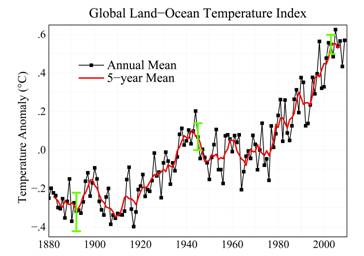
The NY Times Green Blog, citing NOAA, reports that “average global temperatures from April to June and from January to June were the highest ever recorded in those time periods.”

The graph below shows through the year 2009, the warmest years of the past century are 1998, 2002, 2003, 2004, 2005, 2006, 2007, and 2009.

Global Annual Mean Surface Air Temperature Change

« Previous Page