Reports this NY Times article. A hope/problem (?) is that issues like national security, energy independence, and defense are likely to be the issues that lead to new climate policies and renewable technologies.
Climate Change
Archived Posts from this Category
October 5, 2010
“U.S. Military Orders Less Dependence on Fossil Fuels”
Posted by Jason J. Czarnezki under Climate Change, Energy, EnvironmentLeave a Comment
September 27, 2010
“Sugar is sugar” or the Dangers of High Fructose Corn Syrup and Industrial Agriculture
Posted by Jason J. Czarnezki under Climate Change, Consumption, Energy, Environment, FoodLeave a Comment
For those readers interested and concerned about large scale commodity agriculture in the U.S., the reliance of the American diet upon corn and high fructose corn syrup (read Pollan’s Omnivore’s Dilemma), obesity, and/or the carbon footprint of corn (see this article), this video may be of concern.
September 26, 2010
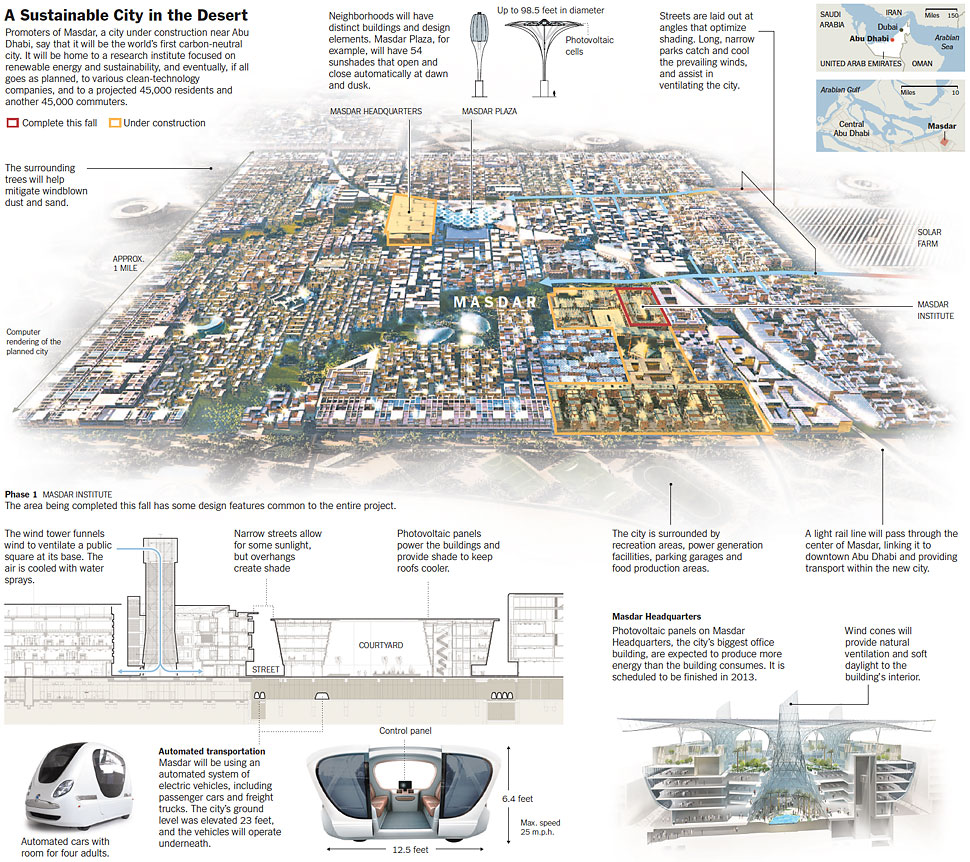
A Sustainable and Zero-Carbon City in the Arabian Desert
Posted by Jason J. Czarnezki under Climate Change, Energy, Environment, TransportationLeave a Comment
Check out this fascinating article and the accompanying photos/designs about Masdar, a being built 20 miles from Abu Dhabi in the United Arab Emirates.
September 16, 2010
Ballot Initiative to Stop California’s Greenhouse Gas Law
Posted by Jason J. Czarnezki under Climate Change, Environment, Law, PoliticsLeave a Comment
A ballot initiative in California proposes to stop the state’s Global Warming Solutions Act (which proposes to reduce greenhouse gas levels to 1990 levels by 2020) from taking affect until unemployment falls significantly (to a point which has only been acheived 3 times in 4o years), likely killing the legislation. As this article makes clear, this ballot proposition is a dangerous mix of referendum politics, special interests, enormous contributions by oil companies, and exemplefies how environmentalism can take a back seat in very tough economic times.
UPDATE: Dan Farber at Legal Planet has an update on the national attention to Prop 23.
September 16, 2010
What Single Book or Article Should I Read to Better Understand Climate Change Policy?
Posted by Jason J. Czarnezki under Climate ChangeLeave a Comment
After I received an inquiry from a friend, I’ve been pondering the following question:
If someone is interested in what policies to pursue in the face of climate change and I could suggest only one very accessible piece to read, what would I choose?
I’ve started asking colleagues this question. Here’s in the beginning list:
- Tom Friedman’s Hot Flat and Crowded
- Elizabeth Kolbert’s Field Notes From a Catastrophe
- Bill McKibben’s Eaarth
Any additional suggestions? Please comment.
September 14, 2010
Legal Challenges to EPA Greenhouse Gas Regulations
Posted by Jason J. Czarnezki under Climate Change, Environment, LawLeave a Comment
A nice article in Greenwire (subscription needed) begins to lay out the legal challenges to four EPA rules that seek to regulate carbon dioxide in the absence of Congressional action. Writes Greenwire:
The four EPA rules being challenged are December’s “endangerment finding,” which determined that greenhouse gases are a threat to human health and welfare; March’s “triggering rule,” a reconsideration of a George W. Bush-era memo that determined when greenhouse gases would be subject to regulation under the Clean Air Act; April’s “auto rule,” which set greenhouse gas emissions standards for cars and light-duty trucks; and May’s “tailoring rule,” which limited the newly triggered rules for stationary sources to the largest emitters.
September 8, 2010
China Leads in Clean Energy Development – Why?
Posted by Jason J. Czarnezki under China, Climate Change, EnvironmentLeave a Comment
According to this NY Times article, China is dominating the production of green technologies like wind turbines and solar panels for a number of reasons: cheap labor, much needed government support, and violation of WTO and IMF rules. The question is whether we should care that the Chinese method in unfair to foreign countries if it is resulting in more affordable green technologies. Certainly, I have concerns about working conditions and social justice (and the loss of American jobs), but the Chinese government is much more willing to (and can more easily) invest in green projects in the solar and wind industry and high-speed rail. Is the problem really Chinese violation of international agreements, or the unwillingness of the U.S. government/Congress/business to promote and require green technologies and forward-thinking infrastructure?
September 3, 2010
A Neverending Cycle: Fossil Fuels, BP, and Cars in America
Posted by Jason J. Czarnezki under Climate Change, Energy, Environment, Law, Natural Resources, PoliticsLeave a Comment
Although BP is standing by its claims to fund projects and make payments to victims of the Gulf Oil spill, BP also claims that federal efforts to curb ocean drilling may curb their cash flow making it more difficult to keep its financial promises. And apparently Gulf drilling is the most lucrative part of BP’s portfolio. See article here. So now we have a neverending cycle: drilling caused environmental and economic damage –> need to pay for damage –> need more drilling to pay for damage, which may result in more damage. Is this always the way for fossil fuel driven projects in America? We sink money into existing fossil fuel technologies and fossil fuel supporting infrastructure like oil drilling, highways, and cars, and there is less incentive to move to new projects (renewable energy, trains) due to the large amounts already spent on existing infrastructure and technology. This was certainly the case with the Stimulus Package, which divided money in such as way that the infrastructure of sprawl will persist, and individual energy consumption and the risk of climate change are being hedged against the creation of carbon-free automobile technology that will drive on existing highways, roads and bridges.
September 1, 2010
A Greener Champagne Bottle
Posted by Jason J. Czarnezki under Climate Change, Consumption, Environment, FoodLeave a Comment
Interesting article in the NY Times about how champagne bottles are being modified in an effort to reduce the carbon foortprint in transit by reducing the weight of the bottle.
August 30, 2010
“Swedes — is there anything they can’t do?”
Posted by Jason J. Czarnezki under Climate Change, Environment, Food, Law[3] Comments
So asks this article about the Swedish music scene. But the same question applies to the Swedish environmental scene, for a country that has proven to be a leader on the issue of climate change, especially in the context of food.
On October 23, 2009, the New York Times ran an article entitled “To Cut Global Warming, Swedes Study Their Plates.” This Swedish movement is driven by two major events: (1) the creation of new national dietary guidelines that give equal weight to health and the environment, and (2) the major organic labels in Sweden embarking on a new initiative called “Klimatmärkingning för Mat,” or “Climate Labelling for Food” in English.
For a few weeks next spring I plan to be a Guest Researcher at Uppsala University Faculty of Law in Sweden to lay the groundwork for a comparative project one environmental labeling for food in the United States and Sweden.
(To hear the music click here and here.)


 JASON J. CZARNEZKI