In a 2003 issue of Science magazine, Tulane Law School Professor Oliver Houck wrote about the troubled marriage between law and science.  Simply put, law seeks certainty and rules, while science deals with nuanced and complex data that is far from absolute.

Climate chage now is arguably more a political issue than a legal or scientific one, at least to the extent nations struggle with whether they should regulate carbon.  In my College Magazine of the University of Chicago, The Core, I came across the winning essay of the John Crear Foundation Science Writing Prize for College Students entitled “Karl Popper and Antartic Ice: The Climate Debate and Its Problems.”  It is certainly worth a read for it illustrates that difficulty that politics (as law) have in dealing with science.

Would you like to be a Fulbright Scholar in China?  It’s not too late.  I just received the following email.

Dear China Fulbright alumni in law:

We are now a little less than a week away from the August 2 deadline for the 2011-12 Fulbright Scholar awards. My recent review of the number of applications in law awards in China–submitted and pending–indicates that for whatever reason there is a significant drop off in the number of applicants in law–both the regular award and the distinguished lectureship.

I am writing to ask your assistance in bringing these opportunities to the attention of potential applicants as quickly as possible. You are probably thinking if there is enough time to submit an application. There is, because if people start their applications by August 2, they have until August 20 to complete them.

To facilitate your helping us with this late recruitment effort, you will find an announcement below that you can send out to list serves, post on a webpage, put on a bulletin board, etc.

Thanks very much for your help.

Best regards,

David

David B. J. Adams, Ph.D.

Assistant Director of Outreach and Communications

Institute of International Education

Department of Scholar and Professional Programs

Council for International Exchange of Scholars

3007 Tilden St. NW, Suite #5L

Washington, DC 20008-3009

202-686-4021 | 202-3632-3442

dadams@iie.org | www.iie.org/cies

The Fulbright Scholar Program and Humphrey Fellowship Program are administered by the Institute of International Education’s Department of Scholar and Professional Programs, which includes the Council for International Exchange of Scholars and Humphrey divisions.

The competition for 2011-12 Fulbright Scholar grants is now open. The application deadline for most programs is August 2, 2010. U.S. scholars and professionals can learn how to present their credentials at www.iie.org/cies.

________________________________________________________________________________________________

The Fulbright Scholar Program in China offers interesting opportunities for specialists in law, especially specialists in administrative, business, constitutional, investment, tax, civil, intellectual property, comparative and contract law.The grants are for 5 or 10 months with a starting date in late August 2010 or February 2011 for one-semester awards and late August 2011 for academic year awards. Grantees are placed in the top Chinese universities. A unique feature of the China Fulbright Scholar Program is a salary supplement stipend. For more information visit http://catalog.cies.org/viewAward.aspx?n=1089 or contact Gary Garrison at ggarrison@iie.org or 202-686-4019.

The Times has a nice article about the problems with using GDP as a measure of success.  This has always been the case in China, which is why city officials in Guangzhou encouraged the purchase of private automobiles to improve/increase production in Guangdong Province, even though Guangzhou is highly polluted and has one of the world’s best subway systems.  In addition to economic measures, the Chinese government is finally beginning to use environmental quality measures (e.g., air quality) to evaluate local officials.

Yesterday my family and I hiked up to the top of Big Deer Mountain in Vermont’s New Discovery State Park (which is in Groton State Forest), followed by swimming at Boulder Beach.  I’d highly recommend the hike for kids; mostly flat and dry followed by a fun uphill rock climb.

State Parks are a fantastic resource.  My Natural Resources Law course includes a lot of discussion about National Parks, and we have an annual field trip to Marsh-Billings-Rockefeller National Historic Park in Woodstock, Vermont (the only national park devoted to America’s conservation history).  But this year, I’m going to spend some time on the development of state parks, and how states have determined how to best protect these resources and for what purposes.

I was a law clerk at the Wisconsin Department of Natural Resources (WDNR) right after the U.S. Supreme Court decided the case U.S. Army Corps of Engineers v. Solid Waste Agency of Northern Cook County (known as SWANCC).  In an interpretation of the Clean Water Act, the case stripped the federal government of its jurisdiction over many wetlands in the United States, leaving them subject to development and fill.  Wisconsin decided to assert state jurisdiction over these wetlands no longer subject to federal jurisdiction, and I helped to play a role drafting the administrative code that implemented the new Wisconsin Statute (2001 WI Act 6).

While Wisonsin has had a fairly progressive tradition in protecting wetlands, the struggle has been in getting other states to protect wetlands.  (See this article.)  My former colleague at WDNR just sent me info on a program from the Wisconsin Wetland Association that seeks to raise awareness about the importance of wetlands.  Called “Wetlands Gems,” they’ve published an awesome book that beautifully identifies and describes that best wetlands in Wisconsin.  I think other states would be smart to compile similar books.

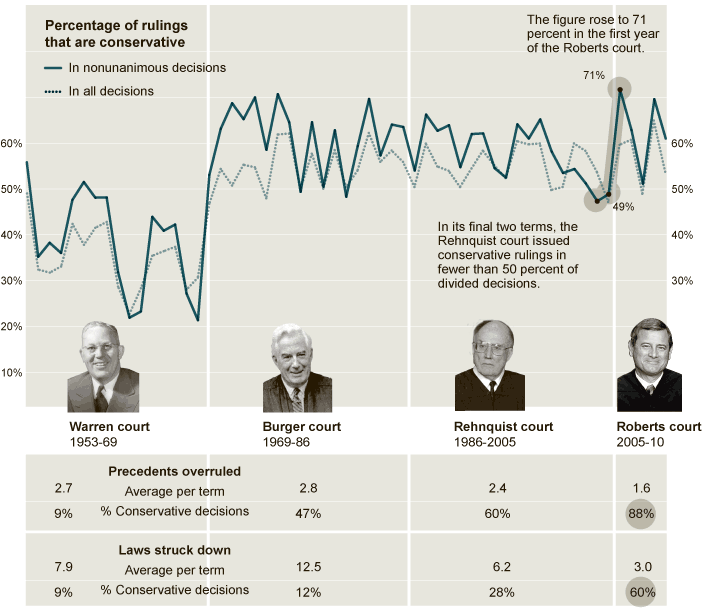
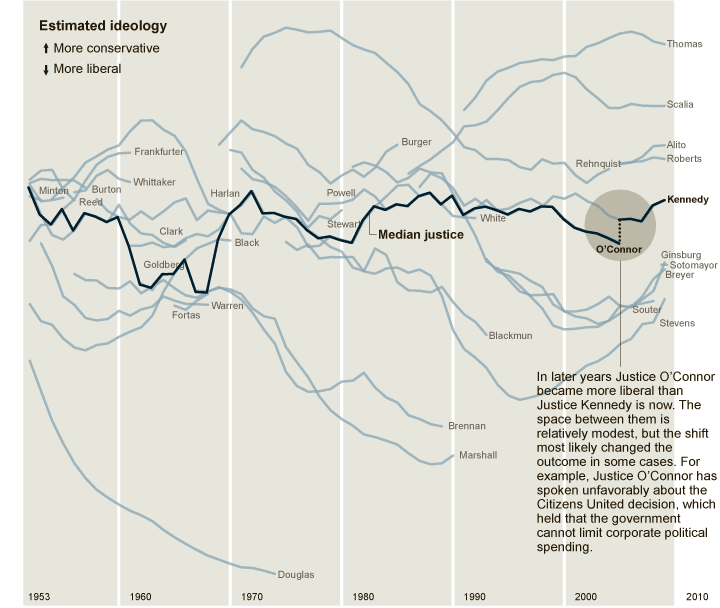
There are two flavors of judicial activism in the U.S. Supreme Court — liberal (e.g., the Warren Court) and conservative (e.g., the current Roberts Court).  The NY Times today has an article titled “Court Under Roberts Is Most Conservative in Decades.”  This is primarily due to the replacement of Justice Sandra Day O’Connor with Justice Samuel Alito.

A confluence of factors brought Justice Alito to the Court: the failure of the Harriet Miers nomination; the justices’ desire not to have two vacancies on the Court at once coupled with Rehnquist’s desire to hang on and O’Connor’s willingness to resign; the poor health of O’Connor’s husband; Rehnquist’s death.

With Alito replacing O’Connor, the Court has moved further to the right, and the data back this up (though I think how much to the right still remains to be seen).  Readers  of my former Empirical Legal Studies Blog will be pleased to see that the NY Times cites and uses data from Martin-Quinn Justice Scores, as well as data from Lee Epstein and Harold Spaeth.

Justice Alito was confirmed by a Senate vote of 58-42 (the second lowest vote total in history behind Clarence Thomas).  The Democrats could have mustered a filibuster.  Should they have?  In purely political terms, yes.  That  said, the next question is a far more difficult one: Should otherwise qualified jurists be kept of the court for political reasons?  This depends on one’s view of the role of the Court and the role of the Senate.

(Source of graphics: NY Times, http://www.nytimes.com/interactive/2010/07/25/us/20100725-roberts-graphic.html?ref=us)

I’m watching the movie Food Inc. while writing this post.  The movie provides more examples of how America’s industrial food system is bad for both human health and environmental health.

Part of the movie discusses “Kevin’s Law,” H.R. 3160, a bill that never became law that would give the USDA greater authority to regulate the meat and poultry industry to help stop the spread of pathogens that result from CAFOs (concentrated animal feed operations) and factory processing.

The Farm Bill also plays a role in impacting American’s diet by subsidizing the production of cheap commodity grain like corn.  This means that industrially produced food, fast food, and snack foods are often cheaper than fresh fruits and vegetables.  If you’re interested in learning more, read the articles Corn, Carbon and Conservation: Rethinking U.S. Agricultural Policy in a Changing Global Environment by Florida Law Professor Mary Jane Angelo and Paying the Farm Bill: How One Statute Has Radically Degraded the Natural Environment and How a Newfound Emphasis on Sustainability is the Key to Reviving the Ecosystem by Bill Eubanks.

If academic articles are not to your taste, try reading The Omnivore’s Dilemma by Michael Pollan.

Via Politico Playbook:

THE AGENDA — “Kerry Says Democrats May Take Broad Climate Bill After Election,” by Bloomberg’s Lisa Lerer and Viola Gienger: “Senator John Kerry said Democrats may take up his comprehensive climate-change bill in a lame-duck session after the November elections, while calling on President Barack Obama to escalate his advocacy for the measure. Senate Majority Leader Harry Reid yesterday introduced a more limited energy bill that doesn’t include a cap on greenhouse gas emissions, citing the lack of support for a broader bill. The bigger measure ‘is not dead,’ Kerry said in an interview on Bloomberg Television’s ‘Political Capital With Al Hunt.’ ‘If it is after the election, it may well be that some members are free and liberated and feeling that they can take a risk or do something.’”


Reports Political WireSenate Democrats said they “had abandoned hope of passing a comprehensive energy bill this summer and would pursue a more limited measure focused primarily on responding the Gulf oil spill and including some tightening of energy efficiency standards,” the New York Times reports.  Explained Senate Majority Leader Harry Reid: “We don’t have a single Republican to work with us.

The question I have is whether this is a good or bad thing.  Absent Congressional legislation, pursuant to the Supreme Court case of Mass. v. EPA, and in light of the EPA’s “endangerment finding” under the Clean Air Act that identifies greenhouses gases as an air pollutant, EPA regulation of carbon dioxide under the Clean Air Act could, if the Obama administration chooses to push it, be far more environmentally successful than any climate change legislation that passes Congress.  But how far is Obama willing to go?

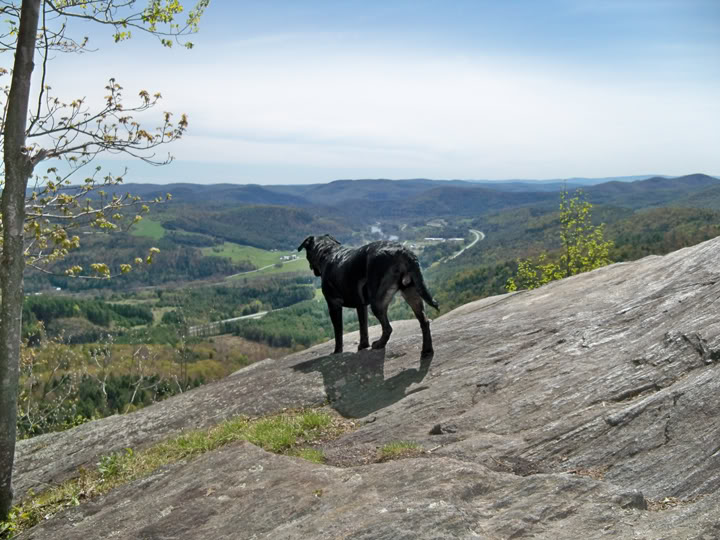
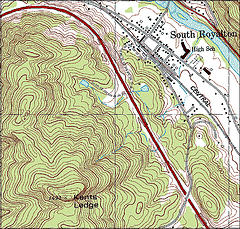
Perhaps one of the best things about being a faculty member at Vermont Law School is my weekly afternoon hike to Kent’s Ledge.   Without ever needing to get in a car, I walk directly from my office to the top of Kent’s Ledge.  It’s about 1.5-2 hours roundtrip.