The past three days have been a whirlwind. On Wednesday morning I lectured to Sun Yat-sen University School of Law graduate students about “Climate Policy and U.S.-China Relations.” We covered topics such as both countries carbon footprints and similar dependencies on fossil fuels, the recent international climate negotiations in Copenhagen and Cancun, cooperative efforts between the U.S. and China to improve energy efficiency technologies, and the domestic political limitations of both countries that hurt efforts for an international climate agreement.

After my lecture, we took a taxi to the airport and flew to the Xi’An. The airport is actually in Xianyang, the capital of the Qin Dynasty and home to the Chinese wedding that we attended. Upon arrival we had a wonderful dinner with the bride, groom, and bride’s parents. The food was excellent, including a noodle dish that certainly was the best I’ve ever tasted in my life; handmade noodles, egg, tofu, greens, onions, and a very spice sauce that was the key ingredient. (The Northwest Chinese cuisine was all around fantastic.)

The wedding banquet itself was a delightful experience held in a hotel banquet hall, and, while the event was celebratory, the experience was also heartwarming and emotional. The parents and children were extremely moved by the moment in a beautiful way. What we didn’t realize was that our family (the only foreigners at the event) would play an important role in the event. Our daughters were the flower girls, and my older daughter was also the ringbearer. I was asked to give a short speech as custom dictates that someone from both the bride and groom’s employer attend and say a few works. Since the bride and I are colleagues, I was the official Vermont Law School representative. I was honored.

On Friday, we woke up early to see Xi’An. It was a windy, cold and snowy day. We left the hotel at 7:30am for a drive into the countryside to see the Terracotta Warriors. We were the first to arrive and had noodles at a local noodle shop before seeing the amazing underground life-size Qin Dynasty statues. The scale is really unbelievable. We then went to see the X’An City Wall which was beautiful. Unfortunately it was too cold and windy to walk around too long. We drove by the Wild Goose Pagoda, and finally found a fancy hotel restaurant for lunch; all before returning to Guangzhou in the evening.

(I note this brief summary of events leaves out the true thrill of our China travels in Xianyang/Xi’An: locking ourselves out of our hotel room; our wonderful guide and driver; driving the wrong way on a Chinese highway; crossing four lanes of traffic on foot; trying to find a restaurant for lunch; successfully getting on an early flight to Guangzhou even though boarding had already begun. These stories are better over drinks, though my partner usually blogs them well at vermont2china.)

As for final notes, (1) the air quality in Xianyang and Xi’An was the absolute worst I have ever seen in my life. A dust-filled haze filled the air, so strong and thick that it entered buildings, and (2) Fasten seat belts signs on Chinese airplanes have no meaning to the passengers.
See here.

We’re in Guangzhou with limited email access, but the return six months removed from my Fulbright experience has been good so far. Tonight I’m participating in a roundtable discussion about some American current events in the legal world, and tomorrow I’m delivering a lecture at Sun Yat-sen University titled, “U.S. Climate Policy and U.S.-China Relations.” Between my many lectures and consistently scheduling meeting with professors, NGOs and officials, this is an extremely busy trip. And, while a few minutes ago my last day in Asia was free, I’ve now booked it to meet folks at environmental NGOs and environmental policy officials in Hong Kong.

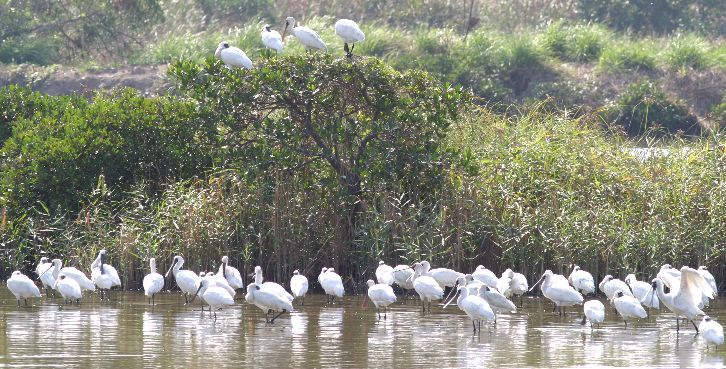
Today, due to the generosity of contacts at WWF in Hong Kong, we received a tour of Mai Po Nature Reserve in Hong Kong’s New Territories.   Mai Po is a large wetland reserve filled with very cool flora and fauna, and really is a bird lovers’ paradise.  Mai Po is protected by the Ramsar Convention on Wetlands, and our visit was truly a treat.   We saw mangroves, traditional shrimp ponds, fish farms (right outside the reserve), and beautiful flowers, and, with fancy digital binoculars and scopes, saw beautiful birds: spoonbills, herons, egrets, and ducks.

Since I’m in balmy Hong Kong, I thought I’d share the environmental headlines from this morning’s South China Morning Post:

“Dalai Lama shifting focus to climate change, US cables show”

“Beijing plans more efforts to control nature”

“Cool heritage: The green credentials of historic buildings are too often overlooked”

“A new bus route”

“Henan suffers power shortage that could worsen amid cold weather”

“Taxi fuel surcharge rejected”

“Airport businesses to cut emissions”

“Formula One takes the greener road”

Finally a photo: “Bottle Bank. A worker piles up plastic bottles collected at a recycling center in Hefei, Anhui province. China, the world’s biggest greenhouse gas emitter, has some of the world’s worst water and air pollution.”

But perhaps the best headline is about a different type of environment: “Singapore launches toilet manners plan”

I just arrived in Hong Kong and am very jetlagged (woke up at 4am). Today, I’m meeting with a series of Hong Kong professors as well as American Fulbright Scholars in Hong Kong.

On the plane across the Pacific Ocean, I finished reading Bill McKibbon’s book Eaarth. I think it’s a book very accessible to the general public, and it’s finest tribute is in making two points. First is the importance of scale; that when creating the next food system or energy transmission technology we need to consider smaller and more diffuse models. Second, he defines the biggest challenges and important items going forward as energy, food, and the Internet. I enjoyed the book, but was surprised so much of it was focused on food and Vermont. For the academic who reads about such issues all the time, this books provides little new information, but provides a useful new narrative. Finally of course the book’s overarching theme is that we live on Eaarth because the planet we lived on before, Earth, no longer exists and has already been changed by climate change.

Competition for grants opens on February 1, 2011. Please contact CIES at 202 686-4000 or scholars for more information about awards and the application process. You may also visit their website at www.iie.org/cies for information and specific program deadlines.

See here.

I’m off to China in less than 13 hours for a relatively long trip packed with events.  I’m meeting with environmental NGOs and academics in Hong Kong, including a much anticipated tour of Mai Po Nature Reserve.  Then off to Guangzhou for a series of lectures on climate change at Chinese universities, attending collaborative American-Chinese student research presentations as part of the Vermont Law School’s US-China Partnership in Environmental Law, meeting with public and private environmental officials, and doing some “public diplomacy” for the U.S. Consulate in Guangzhou.  Also on the agenda is a friend’s Chinese wedding in Xi’An and as much Chinese food as I can eat.  I’ll be exhausted by the time I arrive at the AALS Annual Meeting in San Francisco on the way home.

Asks Green.