And the NY Times lays out some of the interesting cases this term in the article “Justices’ Term Offers Hot Issues and Future Hints.”
Law
Archived Posts from this Category
October 2, 2010
“First Monday”: The U.S. Supreme Court Term Begins
Posted by Jason J. Czarnezki under Law, Supreme CourtLeave a Comment
October 1, 2010
U.S. Dep’t of Interior Issues New Rules on Offshore Drilling
Posted by Jason J. Czarnezki under Energy, Environment, LawLeave a Comment
The U.S. Department of Interior issued new rules on offshore drilling, a necessary step in ending the moratorium, but the moratorium, to this point, remains in effect.
September 23, 2010
Should 17-year-olds be allowed to vote? In Vermont?
Posted by Jason J. Czarnezki under Law, Politics[3] Comments
I’ve always thought that the answer to this should be yes, in primary elections, if they will turn 18 by the date of the general election. This is the law in some states, and now Vermonters will get to decide this issue on their November election ballot.
Section 72 of the Vermont Constitution reads:
At the biennial session of the General Assembly of this State which convenes in A.D. 1975, and at the biennial session convening every fourth year thereafter, the Senate by a vote of two-thirds of its members, may propose amendments to this Constitution, with the concurrence of a majority of the members of the House of Representatives with the amendment as proposed by the Senate. A proposed amendment so adopted by the Senate and concurred in by the House of Representatives shall be referred to the next biennial session of the General Assembly; and if at that last session a majority of the members of the Senate and a majority of the House of Representatives concur in the proposed amendment, it shall be the duty of the General Assembly to submit the proposal directly to the voters of the state. Any proposed amendment submitted to the voters of the state in accordance with this section which is approved by a majority of the voters voting thereon shall become part of the Constitution of this State.
Prior to the submission of a proposed amendment to a vote in accordance with this section, public notice of the proposed amendment shall be given by proclamation of the Governor.
The General Assembly shall provide for the manner of voting on amendments proposed under this section, and shall enact legislation to carry the provisions of this section into effect.
Apparently the state legislature very quietly adopted this constitutional amendment, and now it’s up to the voters. Then the legislature will have to craft implementing regulation if the amendment passes.
September 20, 2010
A Useful Chart about Environmental Administrative Agencies
Posted by Jason J. Czarnezki under Environment, Law, Natural Resources, Teaching[3] Comments
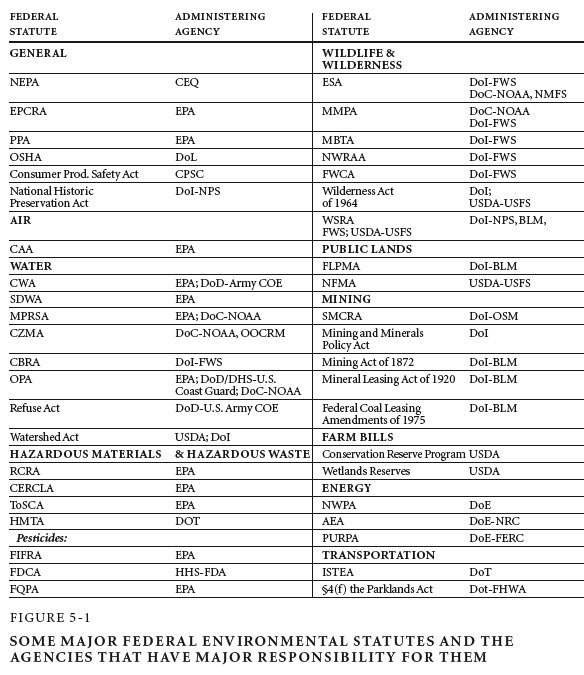
From the new, 4th edition of the Plater, Abrams,Graham, Heinzerling, Wirth & Hall casebook (Aspen).
September 16, 2010
Ballot Initiative to Stop California’s Greenhouse Gas Law
Posted by Jason J. Czarnezki under Climate Change, Environment, Law, PoliticsLeave a Comment
A ballot initiative in California proposes to stop the state’s Global Warming Solutions Act (which proposes to reduce greenhouse gas levels to 1990 levels by 2020) from taking affect until unemployment falls significantly (to a point which has only been acheived 3 times in 4o years), likely killing the legislation. As this article makes clear, this ballot proposition is a dangerous mix of referendum politics, special interests, enormous contributions by oil companies, and exemplefies how environmentalism can take a back seat in very tough economic times.
UPDATE: Dan Farber at Legal Planet has an update on the national attention to Prop 23.
September 14, 2010
Natural Resources Law: Wild Horses and Federal Power
Posted by Jason J. Czarnezki under Law, Natural ResourcesLeave a Comment
After a student in my Natural Resources Law class read Kleppe v. New Mexico, 426 U.S. 529 (1976), he alerted me to this article entitled Horse Advocates Pull for Underdogs in Roundups. If you’re interested in the Property Clause of the U.S. Consitution, animals rights, or the Wild Free-roaming Horses and Burros Act, check out the links.
September 14, 2010
Legal Challenges to EPA Greenhouse Gas Regulations
Posted by Jason J. Czarnezki under Climate Change, Environment, LawLeave a Comment
A nice article in Greenwire (subscription needed) begins to lay out the legal challenges to four EPA rules that seek to regulate carbon dioxide in the absence of Congressional action. Writes Greenwire:
The four EPA rules being challenged are December’s “endangerment finding,” which determined that greenhouse gases are a threat to human health and welfare; March’s “triggering rule,” a reconsideration of a George W. Bush-era memo that determined when greenhouse gases would be subject to regulation under the Clean Air Act; April’s “auto rule,” which set greenhouse gas emissions standards for cars and light-duty trucks; and May’s “tailoring rule,” which limited the newly triggered rules for stationary sources to the largest emitters.
September 12, 2010
Re-Reversing the Flow of the Chicago River
Posted by Jason J. Czarnezki under Environment, Law, Natural Resources[5] Comments
The Chicago River used to flow into Lake Michigan. But since raw sewage from the City of Chicago flowed into the river and then Lake Michigan, the city’s drinking water was often contaminated. Thus, in 1892 a major civil engineering project began–reversing the flow of the Chicago River into the Mississippi River by constructing a 28-mile canal to the Des Plaines River which flows into the Mississippi. Needless to say this did not make the residents of St. Louis happy, who became the recipient of the raw sewage. Law students and public nuisance buffs know of the Supreme Court case Missouri v. Illinois (200 U.S. 496 (1906)).
While many have suggested that the the flow of the Chicago River be returned to Lake Michigan, now a century later, lame duck Mayor Daley has offered his “heavyweight” support for the idea. See here.
September 5, 2010
Toxic Substances Control Act: EPA will not regulate lead shot, but may ban lead fishing tackle
Posted by Jason J. Czarnezki under Environment, Law, Outdoor Recreation, SportsLeave a Comment
Various environmental groups filed a Petition requesting that the EPA ban lead shot, bullets, and fishing sinkers under the Toxic Substances Control Act (TSCA). On August 27th, in this Letter, EPA denied the portion of the Petition related to lead shot because the EPA argues it lacks authority to regulate lead shot and bullets due to the exemption in TSCA sec. 3(2)(b)(v), which exempts “any article the sale of which is subject to the tax imposed by section 4181 of the Internal Revenue Code of 1954.” That section of the tax code refers to pistols, revolvers, firearms, shells and cartridges. Other items are also exempt from TSCA when they are the subject of other federal statutory jurisdiction like the Federal Insecticide, Fungicide, and Rodenticide Act, and the Food, Drug, and Cosmetic Act. However, the EPA may still regulate fishing tackle and are taking comment on this issue. See here and here.
September 3, 2010
A Neverending Cycle: Fossil Fuels, BP, and Cars in America
Posted by Jason J. Czarnezki under Climate Change, Energy, Environment, Law, Natural Resources, PoliticsLeave a Comment
Although BP is standing by its claims to fund projects and make payments to victims of the Gulf Oil spill, BP also claims that federal efforts to curb ocean drilling may curb their cash flow making it more difficult to keep its financial promises. And apparently Gulf drilling is the most lucrative part of BP’s portfolio. See article here. So now we have a neverending cycle: drilling caused environmental and economic damage –> need to pay for damage –> need more drilling to pay for damage, which may result in more damage. Is this always the way for fossil fuel driven projects in America? We sink money into existing fossil fuel technologies and fossil fuel supporting infrastructure like oil drilling, highways, and cars, and there is less incentive to move to new projects (renewable energy, trains) due to the large amounts already spent on existing infrastructure and technology. This was certainly the case with the Stimulus Package, which divided money in such as way that the infrastructure of sprawl will persist, and individual energy consumption and the risk of climate change are being hedged against the creation of carbon-free automobile technology that will drive on existing highways, roads and bridges.


 JASON J. CZARNEZKI