Food


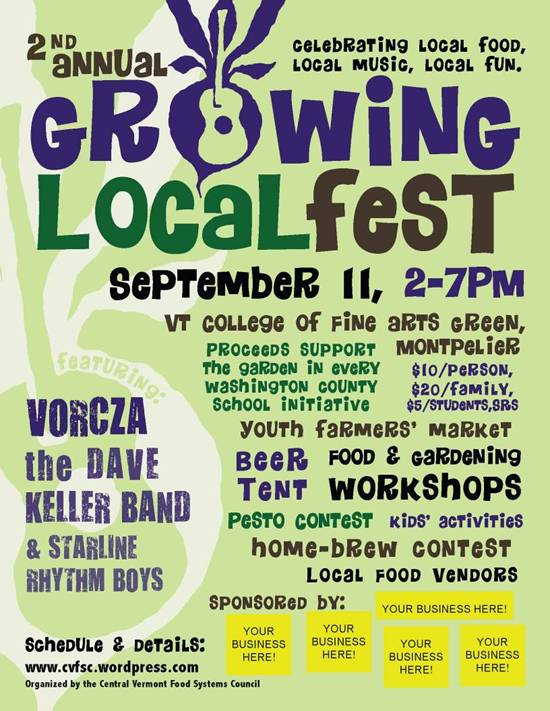
The 2nd Annual Growing Local Fest, a celebration of local food and culture, will be on Saturday, September 11, from 2-7pm at the Vermont College of Fine Arts Green in Montpelier.  The event is being organized by the Central Vermont Food Systems Council (an outcome of enVision Montpelier).

In addition to live music, food- and ag-related workshops, local food vendors, and a beer tent, there will also be a HOME BREW CONTEST, a PESTO CONTEST, and a YOUTH FARMERS’ MARKET!

For the most up-to-date details and schedule of the event, go to www.cvfsc.wordpress.com.

So far most of my blog posts have been about environmental policy or politics or something academic, but now a little about my life — After being away from China for almost two months, I really need some good Chinese food.  Not some greasy Chinese-American restaurant that has no real Chinese food and serves lo mein and egg foo young, and not some upscale Chinese restaurant where they have to explain to patrons what eating family style is, no one speaks Chinese, and where steamed broccoli is $10, but an authentic Chinese restaurant that gives me a rice bowl and chopsticks, uses fresh ingrediants, cooks with chili oil, and has Chinese eggplant in the kitchen.  I’ve tried both of these options and then some, eating at various local Chinese spots and even befriending the owners and cooks.  Even when I order off the menu (in Chinese), these restaurants just lack the proper ingredients or the cooks no longer know how to cook authentic dishes as well as their parents/grandparents.

We will be embarking on an adventure to a Chinatown in Boston, NYC, or Montreal as soon as possible to fill this desperate need.  If you know of an awesome and authentic Chinese in Boston, NYC, or Montreal, please comment with the name and address.

(Note: I did have an actual Chinese grandmother cook at the Chinese restaurant I went to today.   She was very nice and spoke Chinese to my kids.  The food was better, but she said they didn’t have the ingredients for what I wanted in the way it should be cooked, even though it was on the menu to be cooked in the way for Americans–think tofu in a thikc BBQ sauce rather than a light chili oil and bean sauce.)

Doubtful, especially given the amount of methane that dairy cattle produce.  But see here.

With books from Michael and movies like Food Inc., there is increased awareness of the environmental costs of our industrial food system.  My local food co-op grocery store in Montpelier, Vermont, is considering expanding to have a second store in Waterbury, Vermont.  (See the article in the local paper here.)   An issue that has arisen is whether the new store should carry conventional products since many in the community (that walk to the existing grocery store space that would be taken over) are low-income, and conventional food is cheaper.  The problem is that the organic market is already resembling commodity-driven industrial agriculture (e.g., lots of food miles, factory processing, lots of packaging, etc.).  My suggestion is that the new co-op not carry conventional food, but instead consider creative programs so low-income individuals have access to better food products.  Ideas might include free memberships, sliding scale for membership dues based on income, and greater discounts for those already on government assistance.  The Co-Op should continue its committment to being a “member-owned, community-based natural market committed to building a dynamic community of healthy individuals, sustainable local food systems and thriving cooperative commerce,” therby shifting people’s food choices for the better.

I’m watching the movie Food Inc. while writing this post.  The movie provides more examples of how America’s industrial food system is bad for both human health and environmental health.

Part of the movie discusses “Kevin’s Law,” H.R. 3160, a bill that never became law that would give the USDA greater authority to regulate the meat and poultry industry to help stop the spread of pathogens that result from CAFOs (concentrated animal feed operations) and factory processing.

The Farm Bill also plays a role in impacting American’s diet by subsidizing the production of cheap commodity grain like corn.  This means that industrially produced food, fast food, and snack foods are often cheaper than fresh fruits and vegetables.  If you’re interested in learning more, read the articles Corn, Carbon and Conservation: Rethinking U.S. Agricultural Policy in a Changing Global Environment by Florida Law Professor Mary Jane Angelo and Paying the Farm Bill: How One Statute Has Radically Degraded the Natural Environment and How a Newfound Emphasis on Sustainability is the Key to Reviving the Ecosystem by Bill Eubanks.

If academic articles are not to your taste, try reading The Omnivore’s Dilemma by Michael Pollan.

I’ve started reading “Slow Food Nation: Why Our Food Should be Good, Clean, and Fair” by Carlo Pertrini.  In the Forward by Alice Waters, she writes, “We soon discovered that the best-tasting food came from local farmers, ranchers, and foragers, and fisherman who were committed to should in sustainable practices.”

More most be done to promote a local organic food system.  I am working on an article now discussing how law both impedes and can help facilitate such a market.  Not only does local chem-free food taste better, but it limits the environmental costs of food consumption.

Food choices can contribute to the climate crisis, cause species loss, impair water and air quality, and accelerate land use degradation.   For example, an estimated 25 percent of the emissions produced by people in industrialized nations can be traced to the food they eat.   The causes of these environmental costs are many—the livestock industry, a processed and meat-heavy diet, agricultural practices like pesticides and fertilization, and fossil-fuel intensive food transportation, factory processing, packaging and large-scale distribution systems.  These are traits of the dominant industrial food model.

Since I just spent a year in China as a Fulbright Scholar and I grew up in Milwaukee, I found this “Letter from China” in The New Yorker, entitled “Pardon Me, Would You Have Any Pabst Blue Ribbon,” quite amusing.

I noticed a lot of PBR while in China, but I did not know it was going classy.  But I’m not surprised.  For example, Pizza Hut in China has fancy table service and is quite expensive.  Minivans, like the Honda Odyssey, are also considered very high end, especially by young men.

(Note: Despite its label and founding in Milwaukee, PBR is no longer brewed in Wisconsin.)

Hat Tip: Carl Yirka

As many know, I am a big proponent of local food and local farming.  Here in Vermont, we’ve joined Wellspring Farm Community-Supported-Agriculture (CSA) Program.  When we lived in Milwaukee we were CSA members of Rare Earth Farm.

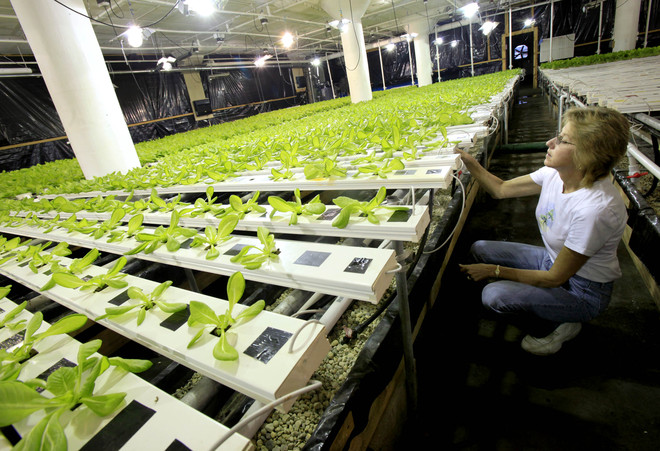
But local does not need to be rural.  Southeastern Wisconsin has two cool urban farms.  Check out these articles about Natural Green Farms built in an old industrial building in Racine and Growing Power in Milwaukee.

Urban Farm in Racine.

A five-story farm that Growing Power is considering building in Milwaukee.

« Previous Page