…headlines this article.
Environment
Archived Posts from this Category
December 6, 2010
VT Gov.-Elect Shumlin names Markowitz to ANR; Mears to DEC…
Posted by Jason J. Czarnezki under Announcements, Environment, PoliticsLeave a Comment
December 6, 2010
Supreme Court Grants Cert in Climate Change Nuisance Case (AEP v. Conn.)
Posted by Jason J. Czarnezki under Climate Change, Environment, Supreme CourtLeave a Comment
December 4, 2010
“Farmers Find Organic Arsenal to Wage War on Pests”
Posted by Jason J. Czarnezki under Agriculture, Environment, FoodLeave a Comment
See here.
December 4, 2010
Climate Change News
Posted by Jason J. Czarnezki under Climate Change, Environment, Law, Politics, Supreme CourtLeave a Comment
(1) A Conn. v. AEP decision soon? Will SCOTUS take the case?
(2) An update on the climate meetings in Cancun. But I don’t see how the U.S. can have such broad international goals given the current domestic politics of climate change.
December 3, 2010
Federal Court Orders Removal of GMO Crop
Posted by Jason J. Czarnezki under Agriculture, Environment, FoodLeave a Comment
See here. This press relaese uses loftier language than the actual opinion, but the crops must be removed from the ground.
December 1, 2010
Book Review: “The Town That Food Saved: How One Community Found Vitality in Local Food”
Posted by Jason J. Czarnezki under Agriculture, Environment, FoodLeave a Comment
I just finished reading “The Town That Food Saved” by Ben Hewitt. It’s a must read for Vermonters who want to know more about the agricultural entrepreneurs in and near Hardwick, Vermont (enterprises like High Mowing Organic Seeds, Pete’s Greens, Claire’s, and the Center for Agricultural Economy). I enjoyed the book both because it’s nice to read about a community in your home state, and because Hewitt recognizes the criticism placed upon high-priced organic artisanal food (something I discussed in an earlier post), and tries to define a successful localized sustainable food system (e.g., economic vitality to small-scale producers, it must feed locals, based on sunshine rather than fossil fuels). Unfortunately, the issue of price/affordability remains, and in his book (and in my own work), there remains no answer of how to make healthy sustainable food more affordable in the face of industrial agriculture. At the end of the book, Hewitt seems to suggest that an economic collapse of the industrial food model may result in price reorganization, but I’m more skeptical of such a collapse and instead have come to belief that big business (e.g., Wal-Mart) will instead seek to control the organic market where these large firms then bring smaller farms under their control by dictating production quantities and growing conditions.
Finally, yesterday I posted about the new Food Safety Bill passed by the Senate. It seems Hewitt has his own take on the bill.
November 26, 2010
A low carbon diet can also be a healthier diet
Posted by Jason J. Czarnezki under Agriculture, Climate Change, Consumption, Energy, Environment, FoodLeave a Comment
Green reports that the InterAcademy Medical Panel is urging a low-carbon diet and lifestyle. This should come as no surprise, but perhaps is long overdue. Many things that are ‘low-carbon’ are much healthier than the alternatives (and both healthier for your personal biology and the environment). Examples abound: red meat v. chicken, chicken v. vegetable, walk v. drive, etc. Sometimes the choices aren’t so clear.
Sweden, with it’s new dietary guidelines that take the environment into account, is on the cutting edge. These recommendations have been suggested for a whole host of environmental reasons in addition to acknowledged health benefits. For example, the guidelines account for the high climate impact of beef due to methane released in cattle digestion, the depletion of many fish stocks, the energy-heavy refrigerated transport required by delicate fruits and vegetables, the fact that fiber-rich root vegetables are more likely to be grown outdoors than in greenhouses requiring fossil fuels, that water-soaked rice fields produce more greenhouse gases than potato farms, that oil palms are often cultivated on former rainforest lands, and even the high carbon footprint of plastic water bottles.
November 22, 2010
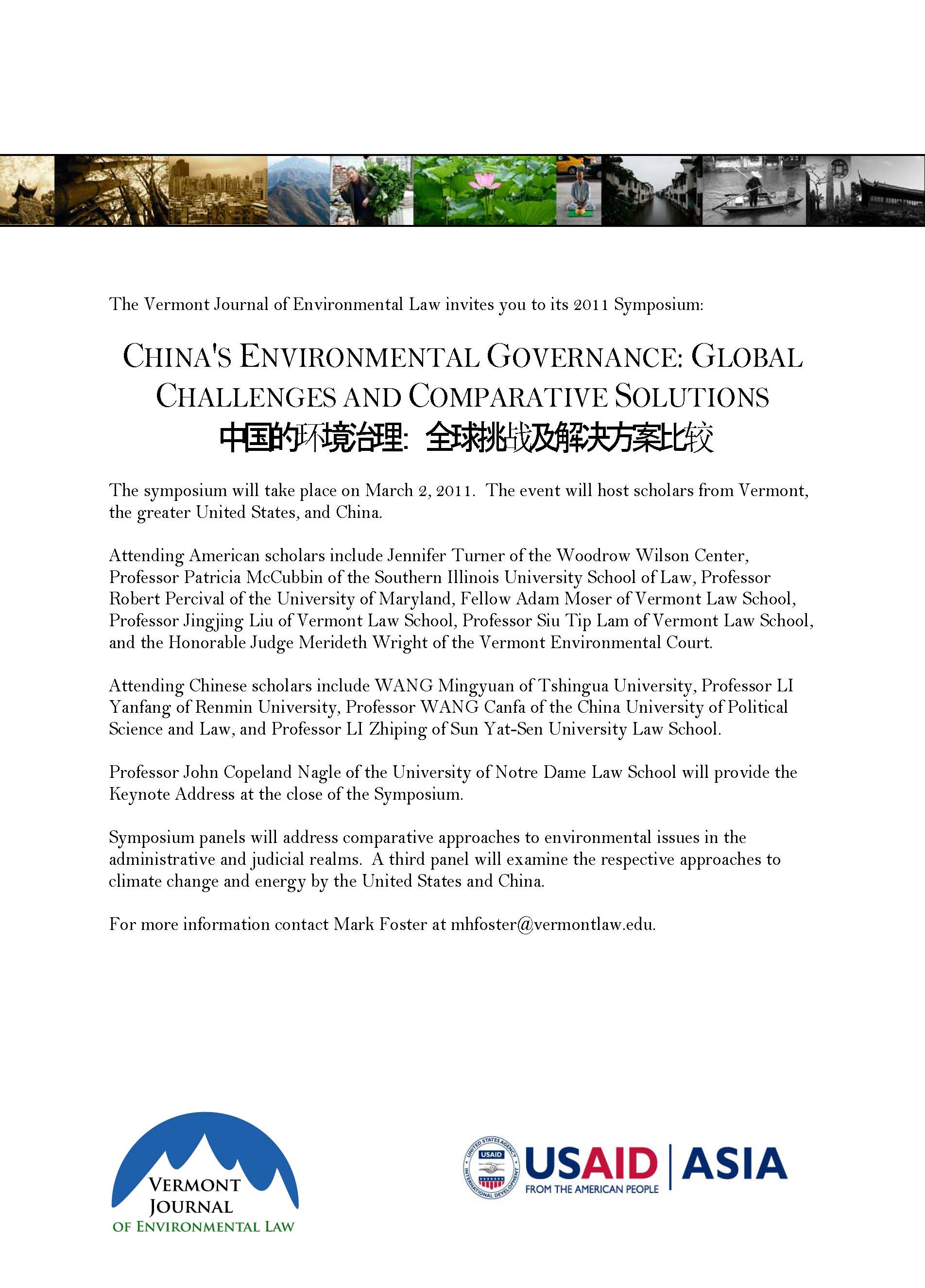
Vermont Journal of Environmental Law Symposium–CHINA’S ENVIRONMENTAL GOVERNANCE: GLOBAL CHALLENGES AND COMPARATIVE SOLUTIONS
Posted by Jason J. Czarnezki under Announcements, China, EnvironmentLeave a Comment
The Vermont Journal of Environmental Law invites you to its 2011 Symposium:
China’s Environmental Governance: Global Challenges and Comparative Solutions
中国的环境治理:全球挑战及解决方案比较
November 21, 2010
China and Coal
Posted by Jason J. Czarnezki under China, Climate Change, Consumption, Energy, EnvironmentLeave a Comment
In the article “Importing Coal, China Burns It as Others Stop,” the Times reports:
Even as developed countries close or limit the construction of coal-fired power plants out of concern over pollution and climate-warming emissions, coal has found a rapidly expanding market elsewhere: Asia, particularly China.
November 17, 2010
Climate Policy and US-China Relations
Posted by Jason J. Czarnezki under Climate Change, Consumption, Energy, Environment, Law, LifeLeave a Comment
I just finished my talk on “Climate Policy and US-China Relations” in downtown Salt Lake City. I really didn’t know what to expect in terms of discussing climate change at a law firm in Utah. All in all it went OK, and the view of the mountains from the 22nd floor offices of Holland & Hart was absolutely spectacular. I had anticipated at least one climate skeptic and had prepared a response but no such questions arose. Instead most folks seems interested in (1) my argument that the Chinese have accepted a cold and Darwinist reality that only economic powers will have the resources to adapt to climate change and thus China sees no need to curb their emissions or limit economic growth, and (2) whether China, and the U.S., are actively preparing climate adaptation measures and projects.
All is all, I’m very much enjoying my time at the University of Utah and the Stegner Center. It’s great to meet environmental law professors at another school, and I’ve been able to catch up with some old friends as well.


 JASON J. CZARNEZKI